The wrist was bad this morning, both knees were bitching... guess that qualifies for another of my rare medical leaves in the last 10 years. 90% of which are contribution from biking related incidents. Can't remember when I last had a fever or other "normal" medical conditions that warrants resting at home.
While getting the paw all wrapped up, I was still pondering on the tire...
...was it more because of my bias after the washouts or is the tire design that's really the cause...With more time to reflect and good daylight, it was another round of photo taking and comparison.
This writeup is more focus on the knobs of various tires, performance related matters has been covered in the earlier writings of this "Tire Time" series.
To clarify, these few articles on tire thoughts may not apply to everyone. Most of my riding is with a bike setup that is gravitated towards pointing down. While it climbs and still maintain respectable speed on the straights but awards definitely aren't coming from those departments.
Tire testing and suitability on the bike means it has to be taken at speed over hard corners and no tire will be bitched or commended if it hasn't seen action in the wet or over slick surfaces. Personally, I think there is nothing much to test on the straights and dry jungle trails. Rolling resistance is mainly a function and design of the center knobs. If it rolls, it rolls. What hampers the rolling on the straight often compensates during climbing over loose steep soil.
The suitability of tires are mainly favored with respect to the usual terrains I ride in. Tropical jungle trails and many sections due to human invasion over time has become hard-pack or fireroads from torn down villages of years gone by. Lots of rolling terrain with a number of steep loose soil interspersed with slick rocky surfaces every now and then. Usually no huge ass boulders but root patches are common. Rain! With 2 monsoons annually and freaky years like this one which see flash floods in the dry season, mud is still not too big a problem but slick leave litter and roots can be really fun without the proper rubbers in place.
Hence some of the things described may not apply to quick and light nimble XC hardtails that will sacrifice some of the surefooted-ness of burly tires for speed or people riding in dry desert conditions etc.
Traction vs rolling resistance on the turns. Its hard to have both. Choose one.
After the recent spate of troubles, I'll now be even more inclined to choose traction. In a full set of side knob patterns on the RQ before the pattern starts repeating, it is a pair of forward facing followed by 3 "concave" knobs.
The green line would represent the bite when the tire turns. The red represents where the lack of knobs will give a no-bite zone until the tire rolls forward until the next pair of forward facing knobs.
The gap in between is significant compared to a few other tires below
The purple lines shows the lack of proper transition knobs. The trailing edge of the side knob (see smaller purple circle) interlocks with the transition knob but is too far inside to give a smooth transition.
The distance between 2 transition knobs are also significant. Although its sandwiching a center knob but the outer edge of which would be too far inside to be of much good during hard cornering.
Compare with the noted spacing of knobs described above with the 2.3 XT Prowler below
Paired side knobs with interlocking paired transition knobs.
Before the traction can break, tire would have rolled off to the next set of knobs.
When cornered hard enough, each of the staggered pairs are likely to "split" and afford more grip. Initially I had thoughts of how fast the knobs might strip but this was really not an issue. In fact with repeated hard cornerings, the signs of wear is evident only during tube changes where rubber from the rim-bead area gets flaked off and remains inside the rim.
This is the third Prowler in as many years as a rear tire. from the Motolite to the El Guapo. I'm pretty confident it works as a front as well....if only it weren't for my fetish of a bigger tire between the fork.
The Ardent 2.4. Inner to outer transition knobs look good and outer transitions interface closely with side knobs. No stupid big spaces in between. Though the knobs are outside relative to the sidewall but its only marginally so. Diving in hard might still be a case of side wall trying to grip the terrain rather than the knobs.
Center ramp knobs is a little too high for my liking but manageable. Therefore even in use as a rear but without flipping direction (ie following the direction as a front tire), rolling resistance is noticeable w.r.t. to it being a ramp knobbed design which should have less of such a feel. However as everything is holding well, I'm not really complaining too much. May experiment with cutting a step in the ramps like I did with some other tires....
The slanting inner transition knobs does slip a bit before the next set grips again but its predictable enough not to cause those "oh sh#t" moments.
Ok...let's dig the rest out for a comparison
Left to right:
2.35 Maxxis Dual ply High Roller DH- a tad small and heavy for this kind of volume..still pondering what to do with it
2.40 WTB Mutano Raptor (which part of it is 2.4???)
2.35 Schwalbe Fat Albert- my all time favorite as a front but this wire bead version is discontinued :(
Got it to try as a rear as Dylon swears by it and from watching behind as he rolls off those steep technical drop downs, it seems pretty good.
Got sent the wrong heavy DH version. Not worth the weight for the relatively small Maxxis sizing imo.
Now that I'm getting all anal about knob designs, just notice that it lacks clear transition knobs. But still given the solid row of side knob that protrudes far out, I'm leaning towards believing that its apt to grip well enough. The outside of the ramp edge should do nicely in transferring the grip over to the side knobs. Not too much empty space in between the area where transition knobs are supposed to be anyway
Since Dirty recently passed me a single ply version, looks like I will be trying it out soon probably on the hardtail.
Yup, cheap as ever, I only got this cos it was on sales.
But when it arrived.. WTF! Even dunking in hot boiling water to expand, doubt it would be anywhere near 2.4
Anyway since it was front specific, I threw it on the Pig for a couple of rides. Hadn't described it much back then. To summarize now, it was anything but confidence inspiring.
Though narrow, some volume was made up with the high tire height.
Now that I look at the tire again and thinking back, it does display similar characteristics to the Rubber Queen when banking into a corner. (Note the wide space between side knobs and a transition knob that is too far in). Also the sidewall was bulging out more than the side knobs for sure.
This, like many of the WTB front/ rear specific tires has knob patterns that arrows inwards leaving too much gaps and quite visually disturbing imo.
I don't look at my tires much when riding (you should always be looking ahead anyway) but with knob patterns like this, the eyes-to-tires syndrome becomes kind of an involuntary response. Rolling wise, it was pretty fast.
Ok, a close look at my all time favorite front rubber.
Cheapo wirebead 2.35 Fat Albert.
Certainly doesn't grip like the rear end Prowler then but not much slippage either. When it does, it finds grip again quickly. Countless time I thought it was going to washout during a turn over some roots but somehow it claws its way back. So much so that I got used to it and use it to my advantage....using the slight slips to force the leech-like Prowler from behind to drift out a little.
Edges of the side and transition knobs are cut to maximize contact with the soil or whatever it may be gripping even though the knobs aren't close-spaced. I'm not sure if the prominent siping on the side knobs are helping in any way.
oh and this tire last forever and ever. On the front, a change is never due to wear but because of rubber hardening over time
an(e)vil
Showing posts with label tires. Show all posts
Monday, July 19, 2010
Sunday, July 18, 2010
Tire Time 4
I really didn't want to start off this 4th writeup tire testing series with a limp and mauled up left wrist. Doesn't help that I'm a Southern Paw too. Ouch. So lets start with the verdict (and hear my bitching scream in caps)
NO MORE FARKING Rubber Queens for me (2.4).
2 Sundays, 2 washouts from the front. One at speed railing a berm in super dry condition. Makeup of the berm can only be described as hard-hard pack with some sandy runoff from usage. Today after the rain, it was an endo for no apparent reason after clearing a rocky double black down line with ass over rear tire . Pressure was a "relatively hard" 25psi (used to run it from 19 psi to the low 20s but been gradually upping the pressure as the tire tend to push rather than roll when at low pressure).
Though the fork has been softened by a couple of psi last night but it wasn't bottomed out at the moment of the endo.The reason could only be a front sliding washout on the slick plate-like rock at the bottom causing the bike to "t-bone" itself in a front pivoting move, catapulting the whole backend despite being weighted all the way rearwards. This is really a first for me, endo with weight back and not even feathering the brakes at all.
Had noted previously the side knobs on the RQ doesn't stick out anymore more than the sidewall. Plus I always had the nagging thoughts that the side knobs on the RQ aren't really up to the job with their relatively sparse alternating designs. Apart from having big volume making it suitable for low pressure riding, it was this reason as I wanted the tire to look for more conformity with the terrain on hard turning and banking.
Anyway at the end of the ride, was discussing with long time no see, Mr Wreck-It-All... conclusion of washing was due to the more prominent protruding sidewall which catches the terrain in a steep turn before the knobs does. He's having the same problem with the 2.4 Nobby Nic on the rear. Knob pattern aside, I realize that both the NN and RQ does indeed spot a very similar profile. High and protruding sidewall, slightly rounded instead of squarish. The side knobs in terms of size is anything but aggressive. Although having slanting knobs may give the impression that the knobs will catch more. However its too sparse...still can't quite figure out for now.
At the same time, I realized that he was using a 2.5 Prowler MX up front...verdict was that it gripped like a leech.
Something I attested to with a similar but smaller 2.3 Prowler XT for rear duty. Still maintain that at first look, this series of tires from WTB looks anything but grippy. Truth is that the secret lies with the staggered pair of transition and side knobs that will flare open when it catches onto something, effectively opening up the knobs surface area for more grip. My only rant then of the Prowler XT was that the actual size is smaller than a true 2.3. But here, the 2.5 MX sure looks good both volume and profile wise. Not heavy accounting that it is a wire bead rubber but just a tad heavy in terms of being on the bike, skewing off the weight distribution on my setup (stated weight of tire @ 952gm)..... Besides, if it lasts on Mr Wreck-It-all's bike, I reckon that's probably more than enough for me.
The other contender for a front would be the much ranted Maxxis DHF....I'm still trying to make sense of all the different models available. Got a feeling, I would still go with a WTB though.
Comparison
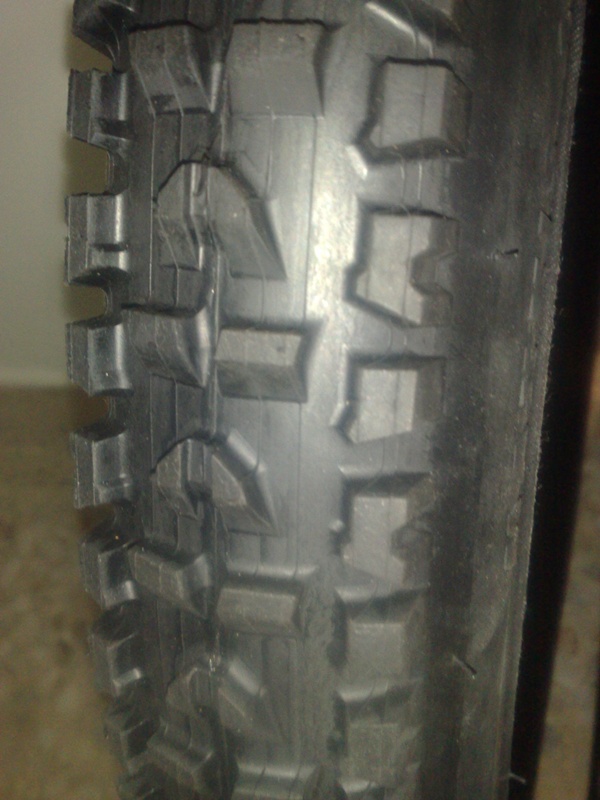
The rubber Queen 2.4. Side knobs with a look that I was never too comfortable with. Also notice that it is lacking any proper transition knobs. On hind sight, now even the spacing between the center knobs looks too wide, just like many of the Continental tires. A further look says the sets of 3 side knobs curving inwards makes for even more side wall exposure to the terrain--no good for traction.

The more squarish 2.4 Ardent on the rear.
Note the knob profiles on both. Carcass wise, the RQ is still marginally larger but the side knobs are definitely way over the side on the Ardent. See next two pics for comparison.
.
Both tires with pic taken from the side. Cam angle not really similar enough to make an effective comparison but still should suffice to see the difference (ie how much knobs are protruding vs the sidewall)
Used Prowler XT (unmounted in pic). Note the side pairing transition and side knobs.
Ok...done with tires.....let's digress
Another one of those Franken-DIY on Wreck-It_All's bike.
This time its a crapped out hydraulic Joplin that's been transformed into a "mechanical" version, similar to a Gravity Dropper!
Lever-- from old vee brake
Spring mechanism
Unbelievable! Seen loads of his problem-solver mods and now this.
My only comment will be to round out the edges on that wadever-u-call-it-spring-thingie.
NO MORE FARKING Rubber Queens for me (2.4).
2 Sundays, 2 washouts from the front. One at speed railing a berm in super dry condition. Makeup of the berm can only be described as hard-hard pack with some sandy runoff from usage. Today after the rain, it was an endo for no apparent reason after clearing a rocky double black down line with ass over rear tire . Pressure was a "relatively hard" 25psi (used to run it from 19 psi to the low 20s but been gradually upping the pressure as the tire tend to push rather than roll when at low pressure).
Though the fork has been softened by a couple of psi last night but it wasn't bottomed out at the moment of the endo.The reason could only be a front sliding washout on the slick plate-like rock at the bottom causing the bike to "t-bone" itself in a front pivoting move, catapulting the whole backend despite being weighted all the way rearwards. This is really a first for me, endo with weight back and not even feathering the brakes at all.
Had noted previously the side knobs on the RQ doesn't stick out anymore more than the sidewall. Plus I always had the nagging thoughts that the side knobs on the RQ aren't really up to the job with their relatively sparse alternating designs. Apart from having big volume making it suitable for low pressure riding, it was this reason as I wanted the tire to look for more conformity with the terrain on hard turning and banking.
Anyway at the end of the ride, was discussing with long time no see, Mr Wreck-It-All... conclusion of washing was due to the more prominent protruding sidewall which catches the terrain in a steep turn before the knobs does. He's having the same problem with the 2.4 Nobby Nic on the rear. Knob pattern aside, I realize that both the NN and RQ does indeed spot a very similar profile. High and protruding sidewall, slightly rounded instead of squarish. The side knobs in terms of size is anything but aggressive. Although having slanting knobs may give the impression that the knobs will catch more. However its too sparse...still can't quite figure out for now.
At the same time, I realized that he was using a 2.5 Prowler MX up front...verdict was that it gripped like a leech.
Something I attested to with a similar but smaller 2.3 Prowler XT for rear duty. Still maintain that at first look, this series of tires from WTB looks anything but grippy. Truth is that the secret lies with the staggered pair of transition and side knobs that will flare open when it catches onto something, effectively opening up the knobs surface area for more grip. My only rant then of the Prowler XT was that the actual size is smaller than a true 2.3. But here, the 2.5 MX sure looks good both volume and profile wise. Not heavy accounting that it is a wire bead rubber but just a tad heavy in terms of being on the bike, skewing off the weight distribution on my setup (stated weight of tire @ 952gm)..... Besides, if it lasts on Mr Wreck-It-all's bike, I reckon that's probably more than enough for me.
The other contender for a front would be the much ranted Maxxis DHF....I'm still trying to make sense of all the different models available. Got a feeling, I would still go with a WTB though.
Comparison
The rubber Queen 2.4. Side knobs with a look that I was never too comfortable with. Also notice that it is lacking any proper transition knobs. On hind sight, now even the spacing between the center knobs looks too wide, just like many of the Continental tires. A further look says the sets of 3 side knobs curving inwards makes for even more side wall exposure to the terrain--no good for traction.

The more squarish 2.4 Ardent on the rear.
Note the knob profiles on both. Carcass wise, the RQ is still marginally larger but the side knobs are definitely way over the side on the Ardent. See next two pics for comparison.
.
Both tires with pic taken from the side. Cam angle not really similar enough to make an effective comparison but still should suffice to see the difference (ie how much knobs are protruding vs the sidewall)
Used Prowler XT (unmounted in pic). Note the side pairing transition and side knobs.
Ok...done with tires.....let's digress
Another one of those Franken-DIY on Wreck-It_All's bike.
This time its a crapped out hydraulic Joplin that's been transformed into a "mechanical" version, similar to a Gravity Dropper!
Lever-- from old vee brake
Spring mechanism
Unbelievable! Seen loads of his problem-solver mods and now this.
My only comment will be to round out the edges on that wadever-u-call-it-spring-thingie.
Friday, July 9, 2010
Tire Time 3...
Just occurred to me over morning coffee if too big a tire volume with too low a pressure has reached a point of diminishing return even if pinch flat is not a concern anymore.
The fleeting glimpse of the new rear Ardent folding in a turn mentioned in the last tire discussion stayed in my mind after Sun ride.
Having been fixated with big volume especially if it contributes to high tire height off the rims, its like added suspension that can really help ease the kick over 4-6 inch obstacles while fast pedaling through by tweaking to low pressures. But the same low pressure causes the folding and retarded steering on hard banking first observed with the 2.4 RQ upfront. Now I know its the same on the rear.
The issue I suspect lies with the height itself. With so much more above the rim even the toughest side walls would be hard pressed to hold itself under low pressure. Not necessarily that only weak side wall tires will have this problem but short of a really tough wire bead, the deformation under force will be significant. Likewise, it seems that upfront the RQ was pushing dirt rather than rolling over.
This would also explain why the Fat Albert 2.35 cheapo wire bead remains my favorite front tire (rear duty dislike is more to do with the knob designs which imo do not hold the lines the way I would like as it tends to break a little more than I would prefer it to) The FA in comparison is only slightly shorter in height but the cheapo version being a wire bead has hardly deflected as much as the RQ up front under similar low pressure of 18-20 psi.
The fleeting glimpse of the new rear Ardent folding in a turn mentioned in the last tire discussion stayed in my mind after Sun ride.
Having been fixated with big volume especially if it contributes to high tire height off the rims, its like added suspension that can really help ease the kick over 4-6 inch obstacles while fast pedaling through by tweaking to low pressures. But the same low pressure causes the folding and retarded steering on hard banking first observed with the 2.4 RQ upfront. Now I know its the same on the rear.
The issue I suspect lies with the height itself. With so much more above the rim even the toughest side walls would be hard pressed to hold itself under low pressure. Not necessarily that only weak side wall tires will have this problem but short of a really tough wire bead, the deformation under force will be significant. Likewise, it seems that upfront the RQ was pushing dirt rather than rolling over.
This would also explain why the Fat Albert 2.35 cheapo wire bead remains my favorite front tire (rear duty dislike is more to do with the knob designs which imo do not hold the lines the way I would like as it tends to break a little more than I would prefer it to) The FA in comparison is only slightly shorter in height but the cheapo version being a wire bead has hardly deflected as much as the RQ up front under similar low pressure of 18-20 psi.
Monday, July 5, 2010
Tire Time 2
Ok I'm just fickle, just when I kinda settled on my next combo of tires, things are looking to change again.
Needed some retail therapy last Friday and next thing I know, there's new rubber in the house, Ardent 2.4 (with EXO protection). Price wasn' too bad, easily one of the cheapest of these truly larger ones that can be bought locally.
Weight is impressive too (at least to me) for such a large tire (non UST version here). Claimed weight is 815gm on Maxxis site. Actual scale reading was ~810gm
Placed it side by side with a 2.35 high roller.... the overall width just blew me away. The extras on the sidewalls already told me how much more height it will be versus many tires of similar size on the market.
Usually front/ rear "dilemma" is pretty clear cut for me but with this the question of whether to mount it on the rear or swap out with the Rubber Queen 2.4 that's now in front was again seeding different ideas in my mind.
5 cups of nerve soothing green teas and probably twice as much nicotine fix later, decided that the RQ2.4 is too much of a bitch to yank off the rim. But at the back of my mind, I am still thinking that the ramp center knobs on the Ardent is probably going to do a much better job on the front hoop...
Putting the tire on was easy. Ran a 2.25 tubbie inside which seems ok for size (running too small inner tubes with big tires brings on its own set of problem). Good thing cos if u forgot the tire lever in the trail and have a flat...
Anyway this is how things look (for) now.
Gearing up for wet muddy and possible rain this morning, which it did, tire pressures were low. 17psi up front and 18 psi in the rear-duty Ardent for the day.
Cornering Traction
With that kind of pressure, commenting on the traction can be a little bias. Still, given the kind of wet condition, the tracking was awesome. But I did caught sight with a backward glance that the Ardent was actually deflecting way more than any tires I have used. Could be due to a combo of the pressure and the use of a less than ideal inner tube.
However nothing was unseated though. After a quick initial assessment while riding, I took a leap of faith in the next series of turn on a down. Leaning and going "brake-less" trusting the tires to take me through. The Ardent did not disappoint, the lower transition knobs didn't look impressive but did their jobs way better than expected, breaking nicely and letting the side knobs take over, which immediately hooks up to every bit of available terrain.
Having been on my old mangy Prowler, getting used to more and more slipping on wet climbs in the last 2 months, the Ardent hook up pretty well even in the wet by comparison. Over slick rock surfaces during climbs, it held much more than expected. More than once, when balance was just about to be lost with a lack of momentum, it was probably the side knobs that took over with effective grip, enabling me to quarter crank and force the next pedal stroke to get out of those situations. While the high rolling knobs isn't terribly efficient on rolling resistance, they probably are helping with more overall traction compared to other center-ramped tires.
Over rock gardens it did the job well too, maybe a bit too well despite the rain. On drier days, it would mean having to carry even more speed through. But then it may have something to do with the front....
Rubber Queen 2.4....continuing the assessment.
Going lower and lower pressure with bigger and bigger tires, I think, has reached a point where even if low pressure doesn't cause pinch flats as in my case but too little air is having negative effects in other way.
Though comfort level was high, the front RQ felt sluggish running around ~17 psi. Hitting down hard on it wasn't a concern. I was doing jumps and landing hard with my usual lack of finesse just yesterday with the same low pressure. Still it carried my weight well enough not to case the rim.
But on continuous twisting and turning in the trail today, the tire pushing dirt and mud much more than before. Even though the bike setup is decidedly rear weight bias, at the bottom of a few troughs, the whole bike bled too much speed as a result of the front pushing instead of rolling. Momentum was lost on the initial burst of the climb ahead.
Next test for the combo...
Putting pressure back up and see if everything still hooks up well for traction and improvement on rolling resistance.
Followed by a front rear swap.
Measurements of the 2 tires as it was run today (at higher pressure, they will probably measure a couple of mm wider and or higher). When measured at the widest point across knobs, both are 59mm on 30mm wide Subrosa rims
Given the RQ is slightly wider but the Ardent being a tad higher, volume wise, both are probably very close.
Needed some retail therapy last Friday and next thing I know, there's new rubber in the house, Ardent 2.4 (with EXO protection). Price wasn' too bad, easily one of the cheapest of these truly larger ones that can be bought locally.
Weight is impressive too (at least to me) for such a large tire (non UST version here). Claimed weight is 815gm on Maxxis site. Actual scale reading was ~810gm
Placed it side by side with a 2.35 high roller.... the overall width just blew me away. The extras on the sidewalls already told me how much more height it will be versus many tires of similar size on the market.
Usually front/ rear "dilemma" is pretty clear cut for me but with this the question of whether to mount it on the rear or swap out with the Rubber Queen 2.4 that's now in front was again seeding different ideas in my mind.
5 cups of nerve soothing green teas and probably twice as much nicotine fix later, decided that the RQ2.4 is too much of a bitch to yank off the rim. But at the back of my mind, I am still thinking that the ramp center knobs on the Ardent is probably going to do a much better job on the front hoop...
Putting the tire on was easy. Ran a 2.25 tubbie inside which seems ok for size (running too small inner tubes with big tires brings on its own set of problem). Good thing cos if u forgot the tire lever in the trail and have a flat...
Anyway this is how things look (for) now.
Gearing up for wet muddy and possible rain this morning, which it did, tire pressures were low. 17psi up front and 18 psi in the rear-duty Ardent for the day.
Cornering Traction
With that kind of pressure, commenting on the traction can be a little bias. Still, given the kind of wet condition, the tracking was awesome. But I did caught sight with a backward glance that the Ardent was actually deflecting way more than any tires I have used. Could be due to a combo of the pressure and the use of a less than ideal inner tube.
However nothing was unseated though. After a quick initial assessment while riding, I took a leap of faith in the next series of turn on a down. Leaning and going "brake-less" trusting the tires to take me through. The Ardent did not disappoint, the lower transition knobs didn't look impressive but did their jobs way better than expected, breaking nicely and letting the side knobs take over, which immediately hooks up to every bit of available terrain.
Having been on my old mangy Prowler, getting used to more and more slipping on wet climbs in the last 2 months, the Ardent hook up pretty well even in the wet by comparison. Over slick rock surfaces during climbs, it held much more than expected. More than once, when balance was just about to be lost with a lack of momentum, it was probably the side knobs that took over with effective grip, enabling me to quarter crank and force the next pedal stroke to get out of those situations. While the high rolling knobs isn't terribly efficient on rolling resistance, they probably are helping with more overall traction compared to other center-ramped tires.
Over rock gardens it did the job well too, maybe a bit too well despite the rain. On drier days, it would mean having to carry even more speed through. But then it may have something to do with the front....
Rubber Queen 2.4....continuing the assessment.
Going lower and lower pressure with bigger and bigger tires, I think, has reached a point where even if low pressure doesn't cause pinch flats as in my case but too little air is having negative effects in other way.
Though comfort level was high, the front RQ felt sluggish running around ~17 psi. Hitting down hard on it wasn't a concern. I was doing jumps and landing hard with my usual lack of finesse just yesterday with the same low pressure. Still it carried my weight well enough not to case the rim.
But on continuous twisting and turning in the trail today, the tire pushing dirt and mud much more than before. Even though the bike setup is decidedly rear weight bias, at the bottom of a few troughs, the whole bike bled too much speed as a result of the front pushing instead of rolling. Momentum was lost on the initial burst of the climb ahead.
Next test for the combo...
Putting pressure back up and see if everything still hooks up well for traction and improvement on rolling resistance.
Followed by a front rear swap.
Measurements of the 2 tires as it was run today (at higher pressure, they will probably measure a couple of mm wider and or higher). When measured at the widest point across knobs, both are 59mm on 30mm wide Subrosa rims
Given the RQ is slightly wider but the Ardent being a tad higher, volume wise, both are probably very close.
| Tire | Rim+Tire Height carcass measurement, no knobs | Tire Height (inch) from rim | Tire Height (mm) from rim | Width (mm) side-side, no knobs | Width (inch) | |||||||||||||||
| Rubber Queen 2.4 with Rim | 80.50 | 2.17 | 55.10 | 59 | 2.323 | |||||||||||||||
| Maxxis Ardent 2.4 | 81.00 | 2.19 | 55.60 | 57 | 2.244 | |||||||||||||||
Monday, June 21, 2010
Tire Time
I hate changing tires. As far as possible, its an avoided chore though as anyone who rides with me knows that I religiously carry a pressure gauge and tune me rubbers according to trails and conditions.
I'm a firm believer that the first suspension in any bike is not in the fork or shock but the tires.
Therefore setting them up in sync with your suspension settings together with fluid flow in the limbs can only then complete the picture of total suspension. Traction is primary. Comfort is secondary but a side effect of being dialed in with all the "suspensions" of riding is usually one that will afford better comfort.
I've been chanting the mantra of bigger tires for awhile. IMO a good bigger tire outweighs the weight penalty. Still it would be silly to lug a 1.5 kg DH carcass on trail rides. It all boils down to what your ride, bike type and yes, in part bodily strength if u aren't simply keeping both wheels to the ground. Rocking a bike or airing can be physically demanding and excess weight especially up in the front wheel just makes for a few more sloppy moves when tired.
Price is always a factor and not all expensive tires are good. On the main 6x6 rig, I have more or less come to a conclusion on the tire types it needs for my kind of riding around here; lots of hardpack and square edges during short steep climbs. The downs are nothing to talk about in our local trails, most bigger tire will give the extra confidence and aggressiveness to chomp down most stuff that can be found. Big aggressive squarish profile in front tends to push dirt rather than roll over it in general. But a rounded profile at the back is too skittish. rear works best for me with a squarish tire but low center rolling knobs.
Having steadfastly hugged 2.35 Fat Albert up front, I wasn't too keen to change to other tires. The notable exception was the love-hate affair with a Rubber Queen 2.4 once..........until now. With only 1 more new spare Albert in the storeroom, this cheapo non folding model I have been using is discontinued with the launch of the new Albert range. No doubt lots of marketing bullshit for more expensive tires to suck the consumers' dollar. Not too convinced from all the reviews available on the new Alberts, so it was time to rethink what could hopefully be the next new tire for the few years to come.
Firstly a little review... 2.35 Fat Albert (touring, non foldable) model has been up front since the Motolite to the present El Guapo. Grips just about anything despite the sparse looking knobs. Initially I had to overcome the feel of the rolling resistance as the last few tires had ramped center knobs like Nevegals and Panaracer Rampage 2.35 which made for much faster rolling. However after a few rides and getting a hang of things, the Albert performed much more predictably, notably from its huge carcass amd was rather confidence inspiring. Weight, is pretty light for a non-folding. Never really weighed but compared to other claimed 750gm tires, it probably felt like 680ish gm.
Molded over 30mm Spank Subrosa, they are pretty wide upfront. Rocking over 2 foot wide dips between roots is not a problem. Can't say the same for most skinnier tires.
As a non believer of UST tires, naturally pinch flatting was a concern. Till date after 3 Fat Alberts in as many years, I had believe it or not, only just as many pinch flats. 2 of them from landing stupidly off-cambered in jumps at low pressure.... and one from hitting a sharp rock seriously hard on a down.
Tire pressure. Every piece of rubber has more or less their own sweet spot. And it is pretty oxymoron to talk about tire pressure without taking into account rider's weight when trying to find the lowest that still runs best without too much flatting.
For me, its 19-21 psi at a geared weight of 75kg.
~21 psi when on the Motolite with a 140mm fork with a bike geometry that has considerably more weight pressed down in front.
~19 psi now on the El Guapo with a more laid back posture, due both to the bike geometry and the way its set up.
How low is too low? A few factors to consider, but my easy way out on days when I am feeling less profound is to size it up with my eye-ball-o-meter. When seated, if the rubber's height deflection is not significant and riding over a consecutive rough patch doesn't bounce like a ball, that's good enuf for me.
Have tried tons of pressure setting and the above always work out. On super wet pouring days where every millimeter of traction counts where I know I won't be taking a jump anyway, the pressure has gone as low as 13-16 psi without ill effect.
High side? Anything above 24-25 psi for me is only good for 1 thing. Riding Tarmac to get home quick after a day in the trails. Once pumped up high, the tire loses its good handling characteristics. On few occasions where trail condition was nice and dry higher pressure certainly made things feel a lot faster on the hardpack but the moment it came to getting controls at the bends over roots and rocks, I wished it would just deflate back to a hair under 20 psi.
On the height profile, it raises ~0.6 cm over the 2.35 Rampage (hence it is overall 1.2 cm bigger in diameter).
Without considering the extra girth, the height alone translates to a huge jump in air volume.
Durability? Sure as hell lasted for long time. Though 3 were changed in 3 years, the last one is still in use on another bike. The earliest was de-commisioned due to rubber hardening over time and not because knobs were too worn down to be thrown away.
Weight of non folding is usually the bane and that actually is where the cheapo Albert shines. You know they always say, "Light, Strong and Cheap, choose 2"-- this one u can have all three and eat it too.
But all good things comes to an end....so today I threw the 2.4 Rubber Queen back on that were used for a couple of months last year. Its bigger than the Albert and the height is a good ~1 cm higher and wider too.
My rant with it is the relatively weaker sidewall that tends to fold at lower pressure. Sure, all the marketing hype about Snakeskin and whatever compounds is stronger .....bottom line, a folding tire is usually weaker when it comes to the tire buckling in a corner compared to non-folding tires.
The last time I ran it, pressure was at ~25 psi, anything lower I would be looking at the wheel more than I like during a run. Yesterday I decided to go with ~21 psi and just not look at it but concentrate on the trail ahead. trail was dry, traction was good. Hit a couple of flights of stairs in between going both down and riding up, no unexpected bounce off.
Putting on the Rubber Queen took a little bit of bitch-yanking technique. Still I managed to do it without the aid of a tire lever. Which is a good thing cos u know sometimes on the trail when u need those little helpers, they somehow go mysteriously missing in your hydro bag.
Overall its 2 cm larger in diameter than when compared to the Rampage from before and almost 1cm higher than the Fat Albert (Carcass measurements, not including knobs).
With a road bike front wheel put side by side, an inflated 2.4 Rubber Queen is almost as large as a 700c wheel.
Maybe not a 29er yet, but sure is close to being like some of those 650 mountain hoops
More trail testing needed but the same feeling of added confidence came back like the first time I had used it. The slight rise up front due to the rubber height was noticeable but not in a negative way. I begin to compress my front and dunk harder on the trail, pumping the bike became easier and less scary. Compensating for a higher front, just have to un-weight a split second earlier into climbing position when going up steep rutted climbs interspersed with rocky square edges.
The back was still somehow mated to my trusty WTB Prowler XT Comp 2.3. Again another tire of choice that has stayed since discovering it 2.5 years ago. Not the widest or most voluminous that my stays could accommodate but the best performing piece for me.
I was changing the rear too after the front but somehow after putting on the WTB 2.55 LT Weirwolf Race, I simply can't fathom how I am gonna ride that piece. Took a look at a 2.35 High Roller, realized that I was sent the wrong model--it was the DH super heavy 2 ply model in my hand. Should have checked the package when it arrived two months ago. Arrghhhhhhh....so I suck thumb and stuck the 1/2 worn down Prowler back on.
Tire Pressure. Initially the tire didnt look like it will grip but after all these while I got the sweet spot at ~21 to 22 psi and it grip like a leech. So if u are the type that likes a little more drifting, then this may not be such a good tire for you. Beyond 25 psi, the noticeable kick from going thru bigger roots is something that my butt can give you a good review on. I attribute part of the grippiness to the roughened surface i between the knobs and the split knobs themselves. When the tire breaks, it will quickly find grip again noticeably starting from the inner row of side knobs. Rolling resistance is something I wouldnt rate as being too low but not silly high and makes u feel sucked down either.
On a side note, the new Prowler SS Race 2.3 with the additional center row of knobs seems to be WTB's answer to something faster rolling but retaining all the other traits of this tire. But how does the extra knob affect centerline traction now that the space in between knobs is filled up as compared to the XT?
All in, from magazine reviews to those of rider Joes, what's described has been similar to my own experience with the WTB Prowler XT, so next purchase? Yah, I'll probably end up with both the XT and the more expensive SS too...
At ~850gm its not light (as heavy as the non UST 2.4 Rubber Queen). For the performance, I wouldn't trade it for anything else now. Oh yes, it is a folding tire but with considerably thick sidewall, which probably explains the weight and also why it would fold in easily during hard cornering.
Durability. Center threads will start to wear a bit thin after a couple of hundred km. But tire will continue to hold.
My early concerns then was the bits of rubber found inside the rims as the side gets sheared off. But each time till I retired the XTs, none had their sidewall rubbed off enough to render them unsafe. The nylon threading on the sides will start coming off making the tire look all mangy but again its only superficial.
Flatting, yes when I start to go silly low on some days like 12-15 psi and insist on ripping thru every piece of tire devouring rock out to catch stupid bikers. Otherwise, again it is a relatively flat-proof tire.
Figured that once the useful life as a hardcore tire is over, could always find it a second life as "semi slicks" on my other bikes that see more gentle riding. No point throwing away perfectly good things. Do your part, save some rubbers.
So for now, my next stable combo looks set to be 2.4 RQ front and 2.3 Prowler XT Comp/ 2.3 SS Race in the rear
Time to sell off all other once tried but otherwise still new tires....
Measurement & Comparison of tires from above
Height measurement is taken at highest flat point of carcass (without knobs)
Width measurement is taken at widest point which could be either at the knobs or carcass.
I'm a firm believer that the first suspension in any bike is not in the fork or shock but the tires.
Therefore setting them up in sync with your suspension settings together with fluid flow in the limbs can only then complete the picture of total suspension. Traction is primary. Comfort is secondary but a side effect of being dialed in with all the "suspensions" of riding is usually one that will afford better comfort.
I've been chanting the mantra of bigger tires for awhile. IMO a good bigger tire outweighs the weight penalty. Still it would be silly to lug a 1.5 kg DH carcass on trail rides. It all boils down to what your ride, bike type and yes, in part bodily strength if u aren't simply keeping both wheels to the ground. Rocking a bike or airing can be physically demanding and excess weight especially up in the front wheel just makes for a few more sloppy moves when tired.
Price is always a factor and not all expensive tires are good. On the main 6x6 rig, I have more or less come to a conclusion on the tire types it needs for my kind of riding around here; lots of hardpack and square edges during short steep climbs. The downs are nothing to talk about in our local trails, most bigger tire will give the extra confidence and aggressiveness to chomp down most stuff that can be found. Big aggressive squarish profile in front tends to push dirt rather than roll over it in general. But a rounded profile at the back is too skittish. rear works best for me with a squarish tire but low center rolling knobs.
Having steadfastly hugged 2.35 Fat Albert up front, I wasn't too keen to change to other tires. The notable exception was the love-hate affair with a Rubber Queen 2.4 once..........until now. With only 1 more new spare Albert in the storeroom, this cheapo non folding model I have been using is discontinued with the launch of the new Albert range. No doubt lots of marketing bullshit for more expensive tires to suck the consumers' dollar. Not too convinced from all the reviews available on the new Alberts, so it was time to rethink what could hopefully be the next new tire for the few years to come.
Firstly a little review... 2.35 Fat Albert (touring, non foldable) model has been up front since the Motolite to the present El Guapo. Grips just about anything despite the sparse looking knobs. Initially I had to overcome the feel of the rolling resistance as the last few tires had ramped center knobs like Nevegals and Panaracer Rampage 2.35 which made for much faster rolling. However after a few rides and getting a hang of things, the Albert performed much more predictably, notably from its huge carcass amd was rather confidence inspiring. Weight, is pretty light for a non-folding. Never really weighed but compared to other claimed 750gm tires, it probably felt like 680ish gm.
Molded over 30mm Spank Subrosa, they are pretty wide upfront. Rocking over 2 foot wide dips between roots is not a problem. Can't say the same for most skinnier tires.
As a non believer of UST tires, naturally pinch flatting was a concern. Till date after 3 Fat Alberts in as many years, I had believe it or not, only just as many pinch flats. 2 of them from landing stupidly off-cambered in jumps at low pressure.... and one from hitting a sharp rock seriously hard on a down.
Tire pressure. Every piece of rubber has more or less their own sweet spot. And it is pretty oxymoron to talk about tire pressure without taking into account rider's weight when trying to find the lowest that still runs best without too much flatting.
For me, its 19-21 psi at a geared weight of 75kg.
~21 psi when on the Motolite with a 140mm fork with a bike geometry that has considerably more weight pressed down in front.
~19 psi now on the El Guapo with a more laid back posture, due both to the bike geometry and the way its set up.
How low is too low? A few factors to consider, but my easy way out on days when I am feeling less profound is to size it up with my eye-ball-o-meter. When seated, if the rubber's height deflection is not significant and riding over a consecutive rough patch doesn't bounce like a ball, that's good enuf for me.
Have tried tons of pressure setting and the above always work out. On super wet pouring days where every millimeter of traction counts where I know I won't be taking a jump anyway, the pressure has gone as low as 13-16 psi without ill effect.
High side? Anything above 24-25 psi for me is only good for 1 thing. Riding Tarmac to get home quick after a day in the trails. Once pumped up high, the tire loses its good handling characteristics. On few occasions where trail condition was nice and dry higher pressure certainly made things feel a lot faster on the hardpack but the moment it came to getting controls at the bends over roots and rocks, I wished it would just deflate back to a hair under 20 psi.
On the height profile, it raises ~0.6 cm over the 2.35 Rampage (hence it is overall 1.2 cm bigger in diameter).
Without considering the extra girth, the height alone translates to a huge jump in air volume.
Durability? Sure as hell lasted for long time. Though 3 were changed in 3 years, the last one is still in use on another bike. The earliest was de-commisioned due to rubber hardening over time and not because knobs were too worn down to be thrown away.
Weight of non folding is usually the bane and that actually is where the cheapo Albert shines. You know they always say, "Light, Strong and Cheap, choose 2"-- this one u can have all three and eat it too.
But all good things comes to an end....so today I threw the 2.4 Rubber Queen back on that were used for a couple of months last year. Its bigger than the Albert and the height is a good ~1 cm higher and wider too.
My rant with it is the relatively weaker sidewall that tends to fold at lower pressure. Sure, all the marketing hype about Snakeskin and whatever compounds is stronger .....bottom line, a folding tire is usually weaker when it comes to the tire buckling in a corner compared to non-folding tires.
The last time I ran it, pressure was at ~25 psi, anything lower I would be looking at the wheel more than I like during a run. Yesterday I decided to go with ~21 psi and just not look at it but concentrate on the trail ahead. trail was dry, traction was good. Hit a couple of flights of stairs in between going both down and riding up, no unexpected bounce off.
Putting on the Rubber Queen took a little bit of bitch-yanking technique. Still I managed to do it without the aid of a tire lever. Which is a good thing cos u know sometimes on the trail when u need those little helpers, they somehow go mysteriously missing in your hydro bag.
Overall its 2 cm larger in diameter than when compared to the Rampage from before and almost 1cm higher than the Fat Albert (Carcass measurements, not including knobs).
With a road bike front wheel put side by side, an inflated 2.4 Rubber Queen is almost as large as a 700c wheel.
Maybe not a 29er yet, but sure is close to being like some of those 650 mountain hoops
More trail testing needed but the same feeling of added confidence came back like the first time I had used it. The slight rise up front due to the rubber height was noticeable but not in a negative way. I begin to compress my front and dunk harder on the trail, pumping the bike became easier and less scary. Compensating for a higher front, just have to un-weight a split second earlier into climbing position when going up steep rutted climbs interspersed with rocky square edges.
The back was still somehow mated to my trusty WTB Prowler XT Comp 2.3. Again another tire of choice that has stayed since discovering it 2.5 years ago. Not the widest or most voluminous that my stays could accommodate but the best performing piece for me.
I was changing the rear too after the front but somehow after putting on the WTB 2.55 LT Weirwolf Race, I simply can't fathom how I am gonna ride that piece. Took a look at a 2.35 High Roller, realized that I was sent the wrong model--it was the DH super heavy 2 ply model in my hand. Should have checked the package when it arrived two months ago. Arrghhhhhhh....so I suck thumb and stuck the 1/2 worn down Prowler back on.
Tire Pressure. Initially the tire didnt look like it will grip but after all these while I got the sweet spot at ~21 to 22 psi and it grip like a leech. So if u are the type that likes a little more drifting, then this may not be such a good tire for you. Beyond 25 psi, the noticeable kick from going thru bigger roots is something that my butt can give you a good review on. I attribute part of the grippiness to the roughened surface i between the knobs and the split knobs themselves. When the tire breaks, it will quickly find grip again noticeably starting from the inner row of side knobs. Rolling resistance is something I wouldnt rate as being too low but not silly high and makes u feel sucked down either.
On a side note, the new Prowler SS Race 2.3 with the additional center row of knobs seems to be WTB's answer to something faster rolling but retaining all the other traits of this tire. But how does the extra knob affect centerline traction now that the space in between knobs is filled up as compared to the XT?
At ~850gm its not light (as heavy as the non UST 2.4 Rubber Queen). For the performance, I wouldn't trade it for anything else now. Oh yes, it is a folding tire but with considerably thick sidewall, which probably explains the weight and also why it would fold in easily during hard cornering.
Durability. Center threads will start to wear a bit thin after a couple of hundred km. But tire will continue to hold.
My early concerns then was the bits of rubber found inside the rims as the side gets sheared off. But each time till I retired the XTs, none had their sidewall rubbed off enough to render them unsafe. The nylon threading on the sides will start coming off making the tire look all mangy but again its only superficial.
Flatting, yes when I start to go silly low on some days like 12-15 psi and insist on ripping thru every piece of tire devouring rock out to catch stupid bikers. Otherwise, again it is a relatively flat-proof tire.
Figured that once the useful life as a hardcore tire is over, could always find it a second life as "semi slicks" on my other bikes that see more gentle riding. No point throwing away perfectly good things. Do your part, save some rubbers.
So for now, my next stable combo looks set to be 2.4 RQ front and 2.3 Prowler XT Comp/ 2.3 SS Race in the rear
Time to sell off all other once tried but otherwise still new tires....
Measurement & Comparison of tires from above
Height measurement is taken at highest flat point of carcass (without knobs)
Width measurement is taken at widest point which could be either at the knobs or carcass.
| Tire | Rim+Tire Height |
Tire
Height (inch) |
Tire
Height (mm) |
Width (mm) | Width (inch) | Tire Height (mm) |
15% deflection inclusive of rim height |
15% deflection
rule not inclusive of rim height |
||||||||||||||
| Tire Dimensions Relationship | ||||||||||||||||||||||
| Rubber Queen 2.4 with Rim | 82.00 | 2.23 | 56.60 | 61 | 2.402 | 56.60 | 69.70 | 48.11 | ||||||||||||||
| Fat Albert 2.35 + Rim | 78.30 | 2.08 | 52.90 | 57 | 2.244 | 52.90 | 66.56 | 44.97 | ||||||||||||||
| Rampage 2.35 + Rim | 72.00 | 1.83 | 46.60 | 54 | 2.126 | 46.60 | 61.20 | 39.61 | ||||||||||||||
| WTB Prowler XT 2.3+ Rim | 75.30 | 1.96 | 49.90 | 53.3 | 2.098 | 49.90 | 64.01 | 42.42 | ||||||||||||||
| Ardent 2.4 with Rim | 81.00 | 2.19 | 55.60 | 58 | 2.283 | 55.60 | 68.85 | 47.26 | ||||||||||||||
| Rim height used for all @ | 25.40 | |||||||||||||||||||||
Subscribe to:
Posts (Atom)


