an(e)vil
Showing posts with label headset. Show all posts
Saturday, January 4, 2014
Slacking
Yea, slacking, is what I have been mostly doing for awhile except during Christmas week, riding 4 days in a row.
Well its really about slacking the HTA with the newly arrived Works Component 1.5 angle headset.
Nothing news worthy... people have been changing head angles for a few years now. Ok, I'm just excited--finally I'm jumping on the bandwagon, plus there could really no more major changes I can push on the EG anymore (I think so).
By my calculation the head angle would be pushed back to ~65.5 degrees with this one final major component change and about as much as I dare to stress on the tubings and geo on this frame.
Why Works Component? Just about everyone I actually know who has gone with the Cane Creek angleset has been bitching about the creak.. thinking about it- it does make sense that it makes no sense the angle change is at the area that also sees the most twisting load/ force exerted upon it. The selling point only remains that you can switch things around and change head angle to your heart content without pressing out the cups by way of the different gimbals. The FSA option seems to be operating on similar principles and its hardly available anywhere in the world wide web or the real world for that matter.
That leaves the fix and forget type like Works Component and K9. But K9 lacks the option I would need. By way of researching all these I have also learned that my EG's headtube follows the 1.5 Headtube standard to the minimum-- ie 102mm length being the shortest and mine measured spot on.
Its important to find the option that spec the correct headtube length as the angle and fit would be dependent on the eccentric offset made into the cups... No rocket science, just basic geometry here.
The other thing about Work's headset as I read is that the bearings are similar to what Cane Creek uses. 45 degree sealed bearings ... theoretically it means I need not remove crown race set into all my forks that are potentially usable with this change... 3 forks to be exact. If there is another part of bike parts removal I never really like performing other than head cups, it has to be the sadistic dexterity involved in prying out races on forks with a flat blade.
Feeling a little apprehensive... thought I better enlist a little help tonite. So first off to friends with proper tools that can perform headset removal with some One-Legged-Monkey-God stance.
After a whole slew of crossing strings and wires like some sniper scope , caliper measurements and center line dissecting technique plus lots of technical gibberish spewed between the 2 of us , all that resulted was few shots at the cups not going in straight and hence any alignment done was messed up...
It was down to the last tool in the box. Eyeball-O-meter to line things up that got everything to work finally... Some days you can have all the bells and whistles in your arsenal but it still takes some spitting and rubbing into the palms and get things done in good old fashion ways.
End result? Oh yea, with everything installed back in reverse order.. turning the bar was baby butt smooth. No clicks, no bumps and no creaks... Visibly, I can actually see the difference. Maybe it is the offset of the stanchions against the headtube at the back. But on the short ride home, yea something has definitely change. Can't say at this point when it comes to technical handling of the bike if everything is all gonna be positive... Ride time in just another few hours will tell
Never thought I would say this but so far after the swap over to the Vector HLR Air... this seems the most suitable shock in my possession to get the suspension talking to each other on the trail with the adjustability making things more versatile and tunable on the trail over the coils.
Sunday, August 29, 2010
Review: Cane Creek XXc Flush II Headset -- Part II
Part 2 of the long term test of the earlier Cane Creek XXc Flush II Headset review
Everything was working fine with no hints of creaks or groans despite the repeated hosing down of the bike after muddy rides. I had not peeked into the headset or bearings since it was installed a year and a half ago. With the fork going out for a servicing, it was about time to take a look at how much havoc I have heaped on it.
First thing out were the bearings and they came out easy. No pinching in the cups. No rusting. Inspection of the outer periphery on the bearings and the inside of the cups shows no abnormal wear (indication of a headset that hasn't been misaligned during installation). The crown race sits into the bearing in the lower cup and is normal to expect some grit and contamination to find its way between the bearing and inner surface of cup as it is not fully covered by the smallish crown race. Was expecting at the very least enough contamination that is sufficient to leave some fine scratches on the metal surface. However little was detected.
The crown race itself that has gone out with the fork was new. Despite being small and thin, there were no signs of any denting (and I have taken more than a few hard hits on landing badly during jumps and all). This was one area I had concerns when first installing the headset but guess now over time it has proved itself not to be an issue.
Rubber cover of seal in lower bearing slightly pitted...probably a result of chemical reaction with salt and water over time. But nothing to worry about.
Upper edge of the lower cup where the bevel edge of the bearing sits is a little rough. To be expected as that would be the repeated impact point time after time as the front end of the bike is pushed downwards. But nothing overly worn and everything was repacked with lots of grease to make the area well lubricated and slick.
Bearing had no play or roughness but just for the sake of checking, the seals were popped revealing bearings and race that are still in rather new looking condition. Shiny balls from eye balling is an indication of little or no pittings. Not gonna break out a microscope to check :).
Just a cleaning and repacking with new bearing grease after this.
Top assembly. Again checking all around for wear and tear, the surface where spacer sits was hardly scratched. all fine prints and decaling originally on headset are still readable
The entire top assembly was even cleaner then the lower cup. Surprising the 1.5 year old grease inside was rather fresh looking.
Picture shows how things look when the top was just taken apart,
The dark blue anodized compression ring was just as new looking. Looks to be well protected by the metal seal (middle of pic on the left) that sits above it. Again no signs of significant wear from scratches as otherwise that would have shown through easily in the anodizing.
Repacked and good to go together with a freshly serviced fork with new dust wiper seals.
Not cheap but certainly a very impressive reducer cup headset and definitely a good investment. With a recessed crown race, it makes this one of the lowest if not the lowest "zero-stack" in the market with only ~10mm total stacking, 5mm top and 5mm at the bottom....there really isnt that many especially if like me, you are looking to lower the front end as much as possible on your bike. Abuse over time has shown this headset stands up to the task of hard riding.
I started off with another rather popular brand of head set in mountain biking but now I'm completely sold on Cane Creek stuff.
Everything was working fine with no hints of creaks or groans despite the repeated hosing down of the bike after muddy rides. I had not peeked into the headset or bearings since it was installed a year and a half ago. With the fork going out for a servicing, it was about time to take a look at how much havoc I have heaped on it.
First thing out were the bearings and they came out easy. No pinching in the cups. No rusting. Inspection of the outer periphery on the bearings and the inside of the cups shows no abnormal wear (indication of a headset that hasn't been misaligned during installation). The crown race sits into the bearing in the lower cup and is normal to expect some grit and contamination to find its way between the bearing and inner surface of cup as it is not fully covered by the smallish crown race. Was expecting at the very least enough contamination that is sufficient to leave some fine scratches on the metal surface. However little was detected.
The crown race itself that has gone out with the fork was new. Despite being small and thin, there were no signs of any denting (and I have taken more than a few hard hits on landing badly during jumps and all). This was one area I had concerns when first installing the headset but guess now over time it has proved itself not to be an issue.
Rubber cover of seal in lower bearing slightly pitted...probably a result of chemical reaction with salt and water over time. But nothing to worry about.
Upper edge of the lower cup where the bevel edge of the bearing sits is a little rough. To be expected as that would be the repeated impact point time after time as the front end of the bike is pushed downwards. But nothing overly worn and everything was repacked with lots of grease to make the area well lubricated and slick.
Bearing had no play or roughness but just for the sake of checking, the seals were popped revealing bearings and race that are still in rather new looking condition. Shiny balls from eye balling is an indication of little or no pittings. Not gonna break out a microscope to check :).
Just a cleaning and repacking with new bearing grease after this.
Top assembly. Again checking all around for wear and tear, the surface where spacer sits was hardly scratched. all fine prints and decaling originally on headset are still readable
Picture shows how things look when the top was just taken apart,
The dark blue anodized compression ring was just as new looking. Looks to be well protected by the metal seal (middle of pic on the left) that sits above it. Again no signs of significant wear from scratches as otherwise that would have shown through easily in the anodizing.
Repacked and good to go together with a freshly serviced fork with new dust wiper seals.
Not cheap but certainly a very impressive reducer cup headset and definitely a good investment. With a recessed crown race, it makes this one of the lowest if not the lowest "zero-stack" in the market with only ~10mm total stacking, 5mm top and 5mm at the bottom....there really isnt that many especially if like me, you are looking to lower the front end as much as possible on your bike. Abuse over time has shown this headset stands up to the task of hard riding.
I started off with another rather popular brand of head set in mountain biking but now I'm completely sold on Cane Creek stuff.
Monday, April 27, 2009
Review: Cane Creek XXc Flush II Headset
What it's for: 1.5" headtube frames running fork with the more conventional 1 1/8" steerers coupled with minimized stack height.
Getting this headset was partly to keep it as close to the head angle of my new frame as the angle published was partly based on using a flush headset. In any case the main concern I had was keeping the front end as low as possible with the foray into longer travel fork to ensure climbing is not compromised.
So while waiting for the frame's arrival, I called up my network to help me hunt one down. Not realizing at that point that the new 09 models have not actually hit our shores (probably available in May 2009). To make a long story short, got my hands on a display piece straight from Cane Creek's booth at the recent Taiwan bike show.
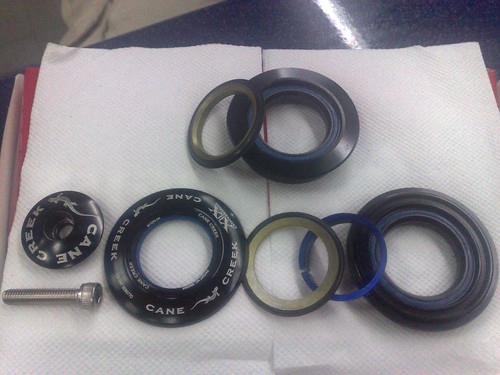
"Exploded" view of the 2009 CC XXc.Flush.II

The new 09 headset has been reworked in many areas compared to last year's model.
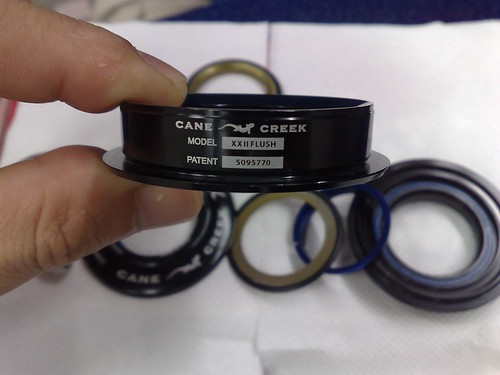
Most noticeable is the base plate. Totally different and much lighter, it sits flush inside the bottom cup holding the bearing in place. In fact when I first got the headset, I was looking for it.
In the 08 model the base plate sits outside the headtube, effectively adding to the bottom stack height beneath the lips of the lower cup.
The blue anodized compression ring is a nice touch. Won't show up after the top cap has been put on but probably more as a mark of authenticity. Imitations are not likely to go that far to anodize the piece. Similarly other marking and identification which once installed will not be not visible.

Total stack height of 10.1 mm after installation is just about there. Slight differences is attributed to my probably less than accurate vernier calipers.
Mine was actually 2 grams shy of the published weight of 109gm on Cane Creek's website
Installation was relatively easy. Tolerance was a little tight with the cups but not a big deal when installed with a proper headset tool. After which bearings are greased and simply dropped into the reducer cups, pop in the compression ring followed by a thin lid surrounded with a rubberized coating.
Took me a while to figure out what this additional piece is for. Turns out that this probably is to further hold the compression ring snug in place and the whole contraption is then further held down by the top cap with a slight pre-load. The rubbers would have helped kept any lateral play to a minimum and maybe just seal off the area from water.
Top and bottom are both using ACB bearings
Graphics overall are really nice even if we are all familiar with the little CC gecko by now.
One small little thing that caught my attention was the spacer groove on the top plate. It is supposed to flush fit with a Cane Creek Interlok Reverse-Top, 5mm (still not available locally). However using normal 1 1/8" spacers doesn't seem to have any adverse effect.
Overall, after proper installation, it does everything a headset is supposed to do. Test ride was in conjunction with the new bike. Up and down the trail, couple of 2 foot drops here and there and pressing it down hard.....nothing came loose and no rattling.
It has been just one actual ride, will probably have to take it out after a few more spins and see if everything is ok. My nightmare is 'what if the headtube becomes ovalized with usage of such headsets using reducer cups?" Guess will have to take a hard look at everything after awhile.
The only other reservation I have for now is actually the above described base plate. It is ultra thin and light. Not too sure how well it will hold up in terms of durability. I guess being able to fit inside the reducer cup would also have meant that less strength is needed on it as part of the forces associated would be taken by the cups itself as opposed to having a clunky piece on the outside. Plus it also has this piece of rubber covering on the outer periphery which likely is to reduce wear as it comes into contact with the inner surface of the cups.
A more in depth look needed after further usage in 2-3 months time.
Though not a fault with the headset but aesthetically running a 1 1/8" steerer on any of the 1.5" headtubes with spacer stack beneath the stem tends to look weird. So far it seems none of the manufacturers had anything but a flat top plate. I would look forward if Cane Creek will come out with (aftermarket?) options of a coned top plate sporting a couple of height variations, as long as it doesnt affect the functionality or becomes an issue of keeping the headset properly in place.
If you need a zerostack headset, go down to wherever its available later. Not sure what the price will be but the attention given to the finer details are really quite telling on this headset and makes it stands out. Have to say, its pretty good stuff so far!
Part II of this review can be found here
Getting this headset was partly to keep it as close to the head angle of my new frame as the angle published was partly based on using a flush headset. In any case the main concern I had was keeping the front end as low as possible with the foray into longer travel fork to ensure climbing is not compromised.
So while waiting for the frame's arrival, I called up my network to help me hunt one down. Not realizing at that point that the new 09 models have not actually hit our shores (probably available in May 2009). To make a long story short, got my hands on a display piece straight from Cane Creek's booth at the recent Taiwan bike show.
"Exploded" view of the 2009 CC XXc.Flush.II
The new 09 headset has been reworked in many areas compared to last year's model.
Most noticeable is the base plate. Totally different and much lighter, it sits flush inside the bottom cup holding the bearing in place. In fact when I first got the headset, I was looking for it.
In the 08 model the base plate sits outside the headtube, effectively adding to the bottom stack height beneath the lips of the lower cup.
The blue anodized compression ring is a nice touch. Won't show up after the top cap has been put on but probably more as a mark of authenticity. Imitations are not likely to go that far to anodize the piece. Similarly other marking and identification which once installed will not be not visible.
Total stack height of 10.1 mm after installation is just about there. Slight differences is attributed to my probably less than accurate vernier calipers.
Mine was actually 2 grams shy of the published weight of 109gm on Cane Creek's website
Installation was relatively easy. Tolerance was a little tight with the cups but not a big deal when installed with a proper headset tool. After which bearings are greased and simply dropped into the reducer cups, pop in the compression ring followed by a thin lid surrounded with a rubberized coating.
Took me a while to figure out what this additional piece is for. Turns out that this probably is to further hold the compression ring snug in place and the whole contraption is then further held down by the top cap with a slight pre-load. The rubbers would have helped kept any lateral play to a minimum and maybe just seal off the area from water.
Top and bottom are both using ACB bearings
Graphics overall are really nice even if we are all familiar with the little CC gecko by now.
One small little thing that caught my attention was the spacer groove on the top plate. It is supposed to flush fit with a Cane Creek Interlok Reverse-Top, 5mm (still not available locally). However using normal 1 1/8" spacers doesn't seem to have any adverse effect.
Overall, after proper installation, it does everything a headset is supposed to do. Test ride was in conjunction with the new bike. Up and down the trail, couple of 2 foot drops here and there and pressing it down hard.....nothing came loose and no rattling.
It has been just one actual ride, will probably have to take it out after a few more spins and see if everything is ok. My nightmare is 'what if the headtube becomes ovalized with usage of such headsets using reducer cups?" Guess will have to take a hard look at everything after awhile.
The only other reservation I have for now is actually the above described base plate. It is ultra thin and light. Not too sure how well it will hold up in terms of durability. I guess being able to fit inside the reducer cup would also have meant that less strength is needed on it as part of the forces associated would be taken by the cups itself as opposed to having a clunky piece on the outside. Plus it also has this piece of rubber covering on the outer periphery which likely is to reduce wear as it comes into contact with the inner surface of the cups.
A more in depth look needed after further usage in 2-3 months time.
Though not a fault with the headset but aesthetically running a 1 1/8" steerer on any of the 1.5" headtubes with spacer stack beneath the stem tends to look weird. So far it seems none of the manufacturers had anything but a flat top plate. I would look forward if Cane Creek will come out with (aftermarket?) options of a coned top plate sporting a couple of height variations, as long as it doesnt affect the functionality or becomes an issue of keeping the headset properly in place.
If you need a zerostack headset, go down to wherever its available later. Not sure what the price will be but the attention given to the finer details are really quite telling on this headset and makes it stands out. Have to say, its pretty good stuff so far!
Part II of this review can be found here
Subscribe to:
Posts (Atom)