an(e)vil

My photo
Existentialism-- Just a bloody good excuse to go riding...
Showing posts with label Test-Ride. Show all posts

Monday, December 6, 2010

X-Fusion Vengeance HLR

Disclaimer: This could sound like a real bias piece and I am having a hard time trying to be objective here. The often drawn comparison to an 09 TALAS is simply because this is the other fork that I am really familiar with and apart from swapping the adjustable travel for a fixed air cartridge, its essentially like a Float.. In my usual overzealous fashion, this probably covers more, making it another epic long post and lullaby read.


Apart from frames, forks usually represent the next biggest investment on a bike, The search for a new fork to replace the aging 36 TALAS had taken awhile.  Like most, I was sucked into the "longer the better" travel vortex. A 36 TALAS or FLOAT 180mm  seemed to be the most obvious choice for awhile...

...till one lazy afternoon over a bike chat session, things sidetracked to the Lyrik 170. Having tried last year's 160mm version and liking it, the 170mm looks to be a real contender.

However at the back of my mind another fork had been lurking. Having followed the development of the X-Fusion Vengeance HLR,  it looks right in just about every aspect.

By the time I was looking at the 170mm Lyrik, I reckon it wasnt really so much in the travel itself and has shaken myself out of the "longestest-possible-travel" stupor.

The TALAS had been a love hate affair. Travel adjust is a bonus on longer climbs yet the reduction throws the whole bike geometry off. Besides, 95% of the time I am on the full 160mm travel with the occasional drop to 130. So much so that the 100mm travel mode is never used. Like most, my TALAS exhibited the usual issues associated with this fork even after servicing and change of oil. The sensitivity of the dials and tracking of the fork was never stellar. Striking a balance between sensitivity and brake dive is a never ending affair.

What I really wanted apart from good tracking was a slightly slacker head angle than the 68 degrees on my bike, hence a longer A-C measurement. 170-180mm would make that slight change which is all that matters on the bigger descending charge or lofting over a big rock and have a more surefooted feel when the front falls over the other side.

Readied the bike for the change with a different bar/stem setup to achieve the same bar height in the event of a fork change. This way (hopefully) it doesn't displace my usual body positions but only have a slacker HA. The anality of this exercise is pinpoint to within ~3mm of all my other bike settings.

So why the Vengeance? As said the actual increase in 10-20mm in travel wasn't the key. Seriously if the whole 180mm travel gets dunked--its can get pretty scary. Furthermore 180mm would really test my bar-stem setup to the limit in trying to get the bar height back at the original 160mm level with the TALAS without the levers hitting the top tube as the front end turns. Things would have been much easier on this last aspect except that the sexy curve top tube on the EG also happens to be sitting pretty high compared to many other frames.


Axle-Crown Measurements
160mm Talas A-C of 545mm (as the benchmark for changes)
180mm Fox A-C of 565mm
170mm Lyrik A-C of 555mm
160mm Vengeance A-C of 557-8mm.

Last but not least, after weighing all the price : weight : performance (read) ratios-- The Vengance just puts a smile on my face. Other brands of overpriced forks just don't even come close. With a 5 day turnaround  time dealing direct with the factory...all that's left now is to check out the performance......


 Weight
Not something I ever give much thoughts to...
Left: Vengeance with uncut steerer @ 2298gm.   Center: Cut to 185mm @ 2270gm  Right: 09TALAS 2282 gm


Without stripping the fork and having a comparable model of other brand(s), there is no way to really tell where all the weight differences are accounted for. Except that the Vengeance runs a negative coil spring with a smaller top out coil nestled within the bigger negative spring. This no doubt would have accounted for a small amount of weight from within. But the fork in general runs alot less oil inside compared to most others in the market. The open bath isnt really "open" as the cartridge sits within another tube which according  to X-fusion also helps to keep contaminants out.

A cursory inspection however immediately yields some interesting observation. If any additional weight is on the outside, then its at all the right places shoring up and reinforcing where it matters most.

Still, what mine weighed in was 100gm lighter than some other much better written reviews (those probably were earlier protos sent out before actual production lots were refined further?)

"Beef"
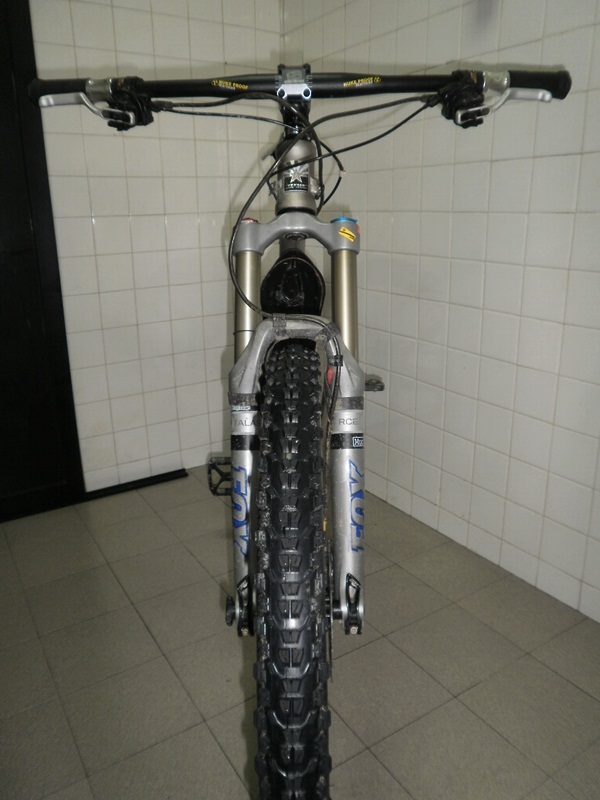
Lowers are definitely burly starting right off the crown. Big and broad with stiffness written all over. Matches the 1.5 headtube well too. Sliding downwards on the lowers, a non-descript bulge much like some of the RS forks Power Bulge can be seen.  Where the stanchion uppers are pressed in, this is another significant area with more material.


 Measurement from top, width of crown on the Vengeance nearing steerer measured ~51 - 45mm (towards the dials). In comparison the TALAS is ~45mm tapering down to ~38mm. Where the stanchions are pressed in, its an additional 5mm more than the TALAS. Accounting for more stiffness? but no doubt surely contributed to part of the A-C increase


Trace it down further, the reinforcement at the dropout area is well thought out. Where the forces of impacts are great, lots of materials are in place to cater for those forces generated.

Left: 36 TALAS  Right: Vengeance HLR


Overall from top to bottom I thought it was more like a 38mm stanchion fork if there ever was one and had to take out my calipers to phyiscally measure to get that thought out of my mind.

Knobs and Dials
Big and the clicks are very positive. Easily adjusted with gloved hands for all 3 from rebound on top to the high and low compressions below. Protective capping for the compression is the nicest I have seen on any fork. Some have commented that the adjustment between rebound clicks is too wide. Maybe it matters to the pros but with 21 clicks, its more than plenty for me to dial in the rebound.

I was simply awed by the finishing on the compression knobs and if you can call it the "ergonomics". The positive indentation of each click takes out any guesswork if you are ever sweating, puffing and making adjustments on the fly in the trail.
really need to get a real camera and not rely on the phone-cam!


First ride out... Sun 28 Nov

Settings
Time and again reviews have mentioned how the recommended air settings are pretty much spot on as printed on the lower left fork leg. It worked well enough for the first ride though some fine tuning will be done real soon. At 160-175lb its 60-67 psi for me

Pinned it to 63psi at my geared up weight of ~170lb. Lo-comp 5 out of 15 clicks and Hi comp at 7 out of 14. Rebound set at 15 of 21 clicks were adjusted to 17 on the trail.

(Tire pressure on the 2.4 Ardents at 20 and 23 psi front and rear respectively).

Time was short, by the time everything was set up it was late afternoon. Off I scooted to the nearest trail.. Tampines. Havent been back since it was re-opened. Though short, but was a little surprised as it's actually pretty smooth and flowy. Nice little berms to carve into and undulations that can test out if the suspension works well enough at speed to float off the top of the soil with the right momentum. Perfect.

No significant dive or excessive bob upfront where most of the ups were squared away with pedaling standing up in the roller coaster trail. None of those XC ass to the saddle spinning needed even with a big fork.

Passing mark with one of my initial concern- rounding a switchback climb. With long travel and burly bikes the last thing is to bleed speed to a crawl during the switchback turn and in turns loses all the momentum to roll up the climbing portion. Problem is the potential to approach too fast and unable to turn in time with a front that starts skipping. Key is the combination of right tire/pressure and good working suspensions to track as one leans the bike without excessive braking.

Next up the series of camel humps. Fork was nice with a firm feel, cresting each one, it takes no effort for the front to lift and put the entire bike into the air. After that it didnt take much for me to ride at the fastest and take every small little undulation to pop the bike into the air and dropping right into the wider berms instead of just riding through them.

In between, the little rock gardens was another good test. Bike goes through everything at speed without the slightest hesitation. Touchdown was surefooted and yes, the slight increase in the A-C making an ever small correction to the HA on the bike was definitely what I was looking for going down. Mentally extrapolating the feeling here to those km long rocky DH lines, reckon I just found my pot of gold boink in this fork.

Throughout, the front was feeling "bottomless" though like any air fork the degree of progressiveness can be felt as it eats into more of the travel. Launching off a rock drop during a descent that usually require more effort and mentally prepping the preloading to lift off was a no brainer here. The front has a mind of its own and just did everything right leaving me to focus ahead on landing. Was definitely going way smoother, akin to skipping rock on water surface. I dont remember having it so easy on the TALAS previously.

The closest in feel would be like Marz smoothness when those suckers don't get stuck down or start crapping oil all over. Comparing it to the Float or Lyrik "feel", somehow those forks while buttery smooth, do impart a somewhat hollow airiness. None of that here. I don't know if having a coil negative spring made things a little different and better. Fork internals are still a relatively complex subject for my understanding.

One thing noticed was the cavitation coming out of the fork. A little distracting but doesnt seem to be affecting performance in any way. I was deducing if the oil level was just that wee bit off and hence the noise. Later a check in a few forum threads shows that this was common and doesnt seem to be an issue in any way.

Overall I think I stumbled onto more of a jump setting although it does ride well enough. But this was a relatively smooth flowy trail with not much in terms of chatter bumps or technical climbs except on the few purpose built rock garden sections.


Second ride out... Sun Dec 5
Everyone was bitching about the slickness in BT from a whole week of heavy rain. A climbing nightmare as usual on SG's oldest official MTB trail.

Observation from last ride says the most logical setting for today's trail is to back off both compressions.
Did that and tracking on slow tech climb was better. Added 2 clicks halfway in to the lap to the rebound making it 19 out of a max of 21 was the biggest positive change. "Lightens" up, making for more positive steering control. I was able to pump the fork more effectively on the faster down and stay in better control. Already mentioned was how positive the dials are but the difference in actual change to the rebound in  1-2 click on this fork is really night and day compared to similar changes on the TALAS.

Nothing negative to comment when the bike is pointed down. Met all my expectations and more. Easy to preload even when coming down fast and let fly on a couple of small drops that usually was just drop in when on the old TALAS.

On the up, the effect of that 1.5cm higher A-C meant having to adjust my weight a little more than usual even though bar height remained as before. Could partly be a case of again changing too many things at once. The 760mm flat bar had been mated to a 70mm stem before. Today its on the new Po1nt Split Sec stem. 20mm shorter.

My heavy overbuilt, low tire pressure setup, a curse when dry is the XC guy's nemesis in the wet.

Didnt meet too many spinning lycra boys today but all the ones I past heaving as their bikes probably went slipping and sliding on the way up probably wondered if there was a Gruber Assist in the EG. Overtaking some of the other bigger bikes in today's ride meant having to get out of the best line and just tear at whatever opening there is. Front tracking was great matching the dialled in rear but the increase A-C effect was really noticeable. More dialling in with the comp settings on next ride to see if that will help.

Let's see what happens 6 months down the road and a couple of trips on bigger course brings. Fork search ended for now.....until the need for a dual crown arise.


Update 23 May 2012: After 20 mths of of trashing around on this fork I have to say it has not really disappointed. From flattish xc in Singapore to mountains in Chiang Mai.. basically I never once had a thought of changing to another fork. As to things like tuning with a different weightof oil and things like that-- I guess this is best left to the home wrenching freaks to figure out what works for them. A change to10w was awesome for a friend but not for me which worked just fine with the stock oil of the damper cartridge. Slick Honeyed inside out was proabably the best thing I did to make everything work as smooth as possible could.

Just that since the new Vengeance Coil is out earlier this year,I decided to go for it and have a full rebuild on this Vengeance Air. Had a bit of a creaky problem (I wouldn't exactly pin it to manufacturing faults-- fact is with bigger stiffer fork, there is a great chance creaks will come along, sooner or later. TO be frank I have been smacking the fork pretty hard with my less than skilful riding)  Sent for a new CSU... waiting out for it to arrive and should finish the rebuld here.


Wednesday, September 8, 2010

EG - A new setup

Dropped the idea of a full DH bike, just can't justify one with the lack of suitable riding terrain.

90% of the time a 6 x 6 setup is overkill for most of the riding around here. But an inch more upfront and a slightly slacker HA would definitely be good for the DH trips in Indonesia and Malaysia. Problem is the change to the bar height position might be too much after plugging a 180mm fork in. Chances are I'm unlikely to keep swapping forks back and forth too. So a compromise has to be made.

One change always lead to another. In a bid to minimize bar height changes with a longer fork and  better leverage with a longer flat bar, I got a 760mm Nukeproof flat bar. This together with the latest swap outs on the EG, a 165mm XT crank and a Blackspire Chain Guide for other reasons.


 Fixed up new crank, swapped back into 2 ring mode with old MRP bashguard

New chain guide in place.....

Time to set out with the bar....but first, just to make make sure differences in ride is not due to shorter cranks, new bar is not fixed on until a lap or two is done with the old barand stem.

Verifying old setup measurements at trailhead.
Bar height spot on with previous night measurement @ 41.25"

Have to admit its pretty weird the way I measure the reach on my bikes. For mtb I take it from a virtual point that is usually halfway at the stem which is dependent the sweep and rotation of the bar....something I term as "Effective Stem Length"... .

The reach is from this point to where it dissects the seat if another virtual line is extended upwards and parallel to the center of the seatpost.

Of course when sitting, it would be a bit further back but these points are easier to fix and measure.

Hence anytime I get a 24" +/- 0.25" for this reach measurement, its 99% sure I pretty much don't need to change a stem or adjust the saddle anymore.


With a flat bar, the initial bar height was a whooping 1.5" lower even with most of the steerer under stem stacked with spacers (~34mm).

Placed both bar/stem combo to compare the actual differences in height and length.


One last pic of old setup to benchmark against future changes
Changed up and tweaked, bar rotated up and outwards after 2 days of testing. Final bar height rests @ 40.75", still 0.75" lower than before and strikes a fine balance between climbing up and bombing down.

Pros and Cons of shorter crank arms
Broke my own rules of bike testing by having multiple component changes at once instead of one at a time. To eliminate shorter cranks from the cockpit changes, bike was ridden with  both new and old bar/stem combos. Basically the 165mm crank is a positive change after fearing for the worst.

With the kind of weight on the EG, it makes more sense to spin on the way up than than mashing on the pedals where a shorter crank would be an advantage. It also allows a wider range of gears in the rear to be used. As it spins faster on the down or straights it means having to change up to 1-2 heavier gear on the rear as compared with using the previous 175mm crank arms. Things might change if the other ongoing project for this bike--dieting of the EG gets underway.

Not enough airtime to tell if shorter cranks make for easier launching and better fine adjustments in mid air.

A key thing to the change was to see if it helps to eliminate pedal strikes. With the thin Point-One pedals, already strikes were very much reduced. With the 165mm I went over the usual spots where the pedal has a 50/50 chance of hitting. Seems to work as under full 160mm travel in front, out of ~15 test spots only once was the pedal clipped on the outer edge.

Front travel was then intentionally lowered to 130mm at some sections which reduces the bb height and the strikes on the pedals were also noticeably reduced compared with previous rides.

Downside of shorter cranks? Having to adjust to quicker shifting when coming out of a descend that rolls back into another steep climb. As mentioned it allows the use of harder gearing, this also means if the gearing ratio is not enough, there is a tendency to over spin and actually losing the initial momentum in a climb. Small adaptation that should be dialled in with another couple of rides.

Other related changes-- a slight raise in the seatpost. No issue as the full  5 adjustable inches is hardly ever needed


Comparison of bar/stem combos.
The swap to a flat bar was originally for accomodating a longer travel fork up front. However there was a positive secondary effect from testing out the change. Climbing.

This is attributed to a combination of both the lower bar height from the ground and the characteristics of a long flat bar.

Long flat bar is nothing new as my initial experience with them was when singlespeeding with a Nitto Torsion and Salsa Cromoto (666 and 685mm with 11-15 degree backsweep). Of course none of those are as ridiculously long as today's standard of 760 to Blackspire's latest offering of a whooping 800mm.

However I believe there is a relationship between bar length and travel. The longer length favored today has a lot to do with longer travels up front which raises the front height of a bike and needs a longer bar to keep it weighted down with less force, hence more agility to steer the front. From another point, whenever I tried to put a longer bar (say a 720mm) on a 100mm travel bike, it just doesn't seem right both in the handling and looks of it.

Back then I have already realized the ergonomic differences of relatively longer flat bar with more sweep but before these long flat bars made popular by the current trend in DH riding, there was just nothing out there to make a change to. So like most people I was stuck with the usual riser bars until now...

I have kept my ideal "reach" distance constant  in both setup at 24" +/- 0.25. However with the lower front and 4 cm additional in bar length, the front loading is noticeable. Things felt more "xc" with the accompanying numbness of xc riding in the saddle area and a tad uncomfortable when pressed against the nose. A slight tilt down of the saddle is needed. Slight departure from my usual saddle position.

But overall the change has helped made climbing much more positive. Nothing beats the 2  test section at Bukit Timah. First the oxymoron uphill rock garden. With the old riser bar+50mm stem, it was a 70/30 make-or-break at 160mm front travel. Wet and slippery days will usually fare worse when the rear starts to slip and the front hit the unavoidable foot high rock that is lodged smack in the middle of the line. Second is the usual short but steep 45 degrees concrete climb that gets everyone swearing under their breath.

On the new bar combo with the 65mm stem it was quicker to steer and the front felt lighter. Just a slight tad more twitchy but manageable. Unweighting the front to pull up over obstacles was easier despite the lower front end. Really strange as the opposite was expected with a flat bar at a lower height from the ground. Still can't really figure out where I got all the leverage from. The longer bar alone doesn't seem quite enough to explain it.

The overall climbing feel can be compared to a bike with lesser travel. While not as nimble as a 100mm XC bike but maybe more like a good geometry bike spotting 120-130mm front travel.


New Setup
760mm Nukeproof with 9 degree backsweep and Sunline 65mm AM stem


Old setup
720mm Funn Fatboy 9 x 5.5 degree back and upsweeps, 30mm rise with Titec El Norte 50mm stem


What usually works for the ups will work against the downs and vice versa. This is where (I think) the characteristics of flat bar with more sweep makes for a difference compared to traditional flat and riser bars.

Though the backsweep is 9 degrees but on a flat bar it somehow translates to more, putting the hands in a more neutral position than a 9 degree backsweep riser.


The rise in a bar has a psychological impact for me, giving more confidence when the bike is pointed down. Not sure why. With the flat bar, I have to fight this missing "factor". As the bar was a little lower than before and wider now, it could also have accounted for the fact that on the faster and rougher descents, it gave rise to a more heart dropping feel as the travel gets used towards the max.


Consequently it led to shifting the weight a little more rearward than usual. However once the adaptations were made, all the descents had a more fluid flow when turning. Together with the front being lighter to steer (despite a longer stem) flicking around the bends while descending was surprisingly easier. Before, I often had to use more lateral motions (body English) together with turning the front to swing the bike and get out of the tighter corners. Now the turns are approached with the outer leg pressed in to get a better grip earlier as there is no need to swing the body as much.

From pure numbers, I have gained a buffer of ~38mm to cater for an additional 20mm increase in front travel. Plenty enough in that aspect but need to watch for lever position hitting top tube as there is lesser clearance when the bar is turned.

Only thing to be wary of was the tight spots between trees while meandering with a longer bar.

However things will probably change again when a 180mm fork replaces the current 36 TALAS with a ~0.5 degree slackening in the HA. Guess more tweaks by then.

Monday, June 28, 2010

DIY Time Again: Thrust Bearing for the Coil

As usual, trust Dirty and his rancid mind to start another tinkering project or bring in another new component. Who else in his gang of dumpy old fart pals he got to be tester again this time!

Toyed with the idea before and read up some more here about the Obtainium adapters and removing the spring binding from the coil and thus eliminating another friction point on the shock.


Gotten the right size bearings for the shock with accompanying washers. Turns out to be 3gm lighter than claimed weight of 28gm


Grease up, slip into shock and adjusted preload as before. 1- 1 3/4 turn....to the point where it takes a bit of force to move the spring laterally.

About to swap a new Rubber Queen 2.4 on the rear but thought that might change things a bit and detract from noting what difference the bearing may make on my usual stairs+carpark-root -simulation.test. So no change and all settings on bike remains.


For now, it's lacking an adapter cup. However internal ID of bearing and washer leaves only ~1mm with the raised part of the lock ring when they are housed over it. Hence everything is sitting nicely with only the slightest bit of wiggle. Greased up and preloaded, lateral movement is further minimized.

[Note: when machining a cup will have to take into account the OD of spring and check thickness of material.

Can't fit a vernier caliper in the space to measure so to the best of my Eye-Ball-Caliper ability:


When pushed downwards, clearance of coil OD to piggy body is only ~4mm


When pushed upwards away from the piggy, clearance is max ~8 mm.


The Stair Test


...Straight out the lift and down the usual flight of 14 steps, slamming on the brakes just before the front wheel hits the last couple of step.

Expecting the same chattering rear like the last thousand time I did it... All I can say is things somehow seems to smooth out and those little kick from the rear is almost non-existent.

Strange, would have thought the effect of the bearings was to work more significantly in the last 1/3 stroke of the shock to ease the coil binding effect where it is most extreme.....

But I'm definitely not complaining....if this "smoothing out effect" or wadever u want to call it is not due to my imagination, I'll be smiling throughout the dense rooty downhill sections in some of our local trails come this weekend.


Carpark Root/Rock Simulation Test


Full throttle...just pedal on a higher gear. No significant difference from before putting on the bearing. Everything tracks just as well. Maybe the only absent thing is any knocking sound. Not sure if why or if the bearing somehow has got to do with it.


Stomped on the same place again in reverse direction but this time in granny. Nothing unusual again.

But this is the first time I see how slack a chain can get when ramming through a series of humps an ledges on a granny gear. Guess that explains the chain slaps I keep hearing on the trail. The previous chain guide was a love hate affair, decided to take it off last week for good.


Last thing I notice was doing tight turns around the carpark. Somehow the turning radius seems "smaller" and easier to manage out of the turn even when seated. Again cannot confirm if there is any change caused by the bearing but at max compression point when rounding a turn, I swear the sping rate felt lighter and making the rear track leech-like. Should be fun to test on berms this weekend.


Final Test...actually still trying to perfect my yet to be perfect J-hop from flat on the EG...
Ok I admit, this has absobloodylutely nuthin' to do with testing the bearing ...


Arrrghhh damn it, shifted my weight a split sec too early again. FARK $*@$*#Y#%$O*^O&$]

Sunday, April 11, 2010

Long travel XC-- The Test

Continuing from before, took the bike out at 5am this morning to test out if things will work to mimic XC handling with long travel and slacker angles than those usually associated with typical "XC" setup.

100mm 6 degree stem flipped down still felt a little short but manageable esp after some field tweaking after the first lap. Apart from that, rear traction suffered due to my cheapness on insisting to use an old tire (Fat Albert 2.35) that's probably overly hardened from the elements from 2 years of on/off usage as a front rubber. Promise I'll kill it and change to the new 2.55 WeirWolf LT Race by the next ride.


Bike setup Notes:
100mm 6 degree stem (flipped down) matched to Nitto Torsion Bar on a 16" Ragley Blue Pig
Suspension: PIKE 454 sagged 40-42mm ( 28-30%) 
Tire Presssre : Front, 2.4 MutanoRaptor @ 19ish psi and Rear 2.35 Fat Albert @ 20.5ish psi
Geared up Riding Weight: ~75kg
Tire height deflection @above weight and pressure, probably ~20% deflection against unweighted bike. Not too concerned, so long as its not puncture prone.

Today's riding condition: Wet and gritty interspersed with smelly grey muddy gooey patches. Challenge for traction on the usual rocky climbs that gets slicker when wet.
Fork broken in previously, so stanchion stiction won't be a factor for those sudden weight shift over slow turnings on the climb. Something I find especially acute in a make-or-break it section as front travel gets longer and bar height of bikes increases.

Key to the whole XC-able setup lies with the the right bar & stem as I have earlier suspected. From last week initial doodling with a 70mm Raceface Diablo which made the front felt way too short, the current 100mm still felt inadequate and I kept thinking "what if the stem is now at 110, no, better yet, 120mm..."

When placed horizontal to the ground with the full 15 degrees backsweep as favored by many during singlespeeding, the chromo Torsion Bar felt short (and it is short by today's standard at 666mm). Weird too, as almost the whole front wheel kept looking back at me when me nose start pushing forward on the climbs.

Tilted the bar up before the 2nd lap which lessen the sweep and made the stem felt a little longer. Ergonomics were also improved and the "scoop" allowed for the front end to be pulled up more easily over logs but not to the point of making the front end twitchy.

(Note: Just measured the thing and 15 degrees sweep effectively negate about 55mm off the length of the stem. Therefore if stem is 120mm, effectively that will be roughly equivalent to the upper recommended stem length of 70mm that's meant for this frame. Which is in line with what I felt when using a normal riser previously with the 70mm Diablo. Have a hunch that when it was designed around 50-70mm, the bar length in mind was probably around 700mm. Therefore the whole flat bar big sweep and long reversed stem setup really only does one significant thing: KEEPING THE FRONT END LOW  ).


End of ride, all hosed down and ready for chow time.

The Ride & Handling
Not being lazy and moving the body more fluidly helps with the steering. Getting a set of good tires would be crucial on days like this. something that will give the confidence to rail without fear of the side knobs breaking before they should in a turn.

Ease of climbing without being conscious of a high front that needs an excessive conscious effort to shift the weight up front too much (Yes, the steep seat tube angle of this frame really does help a lot).

Typical fast turns on the down is a bit retarded as to be expected with longer stem and a relatively short short bar used here but nothing too scary. Again moving the body along helps greatly as compared to sitting one's ass squarely on the saddle on everything

Verdict: Definitely do-able as an "XC" even with a heavy setup like this (~14+ kg??)
Some fine tuning and having a lighter kit will probably help but for weekend "AM" warriors looking to get their occasional XC fix. But for non weenie like me, its good enough.

Slap a change back to a low riser with a 50-70mm stem--the bike changes back instantly to as "AM hardtail" as an "AM hardtail" can get!

Saturday, April 3, 2010

Long travel XC?

Ever done a quick search of "XC vs AM bikes"? Well, I'm not even gonna try and make sense of some of the things said. Frankly I think all AM bikes first evolve from rigid to "XC" and the quest for ever longer travel for better comfort on rides over time.

Sure, things got beefier as more designs started catering for stronger tubing, design and tweaking geometries to accommodate the increase in travel and the rigors that comes with it from the bigger poundings in the trail.

Some of course argues its the difference of how hard you can huck an AM over an XC as stronger frames and longer travel lends itself to the wilder side of riding. Manufacturers obviously cash in on all of these if they haven't already bucking the trends in the first place and soon the market got flooded with components that were touted one or the other or better yet, do-it-all kind of riding.

I was sucked into the longer travel camp few years back after having gotten bored with hardtails on 80-100mm. travel. The fun factor was definitely a draw and soon bombing down fast was a bigger priority than climbing up.


(my last HT before packing up for the "AM" camp, circa 2007)

The first "AM", my ex-Motolite could do only with climbs at 120mm. At its intended max 140mm travel, the front starts twitching everywhere. Even in its most beefed up form with considerable weight in front, running no spacer stacks below stem with lo-riser bars and all...its really nothing more than a long legged XC bike at best.

The geometry just wasn't right. At the time, the debate on whether something is climbable is still very much centered around just the head angle and seat stay length. Any headtube angle with a starting number less than a "7" would be frowned upon when it comes to discussion on being an efficient climber.

Pure XC frames with 71-72 degree head angle and 16.75" stays were still pretty the default numbers from the lycra toting camp.


Things started shifting towards slacker head angles and longer travel but all built into a light package and many folks were willing to sacrifice a little nimbleness for the added comfort (and I suspect there is a linear relationship of longer travel and confidence when it comes to pointing the bike down, though most won't care to admit but excuse it purely by saying that a lot of technical downwards meandering can only be achieved by long travel fork).
Other areas that affected handling were ever shorter stems with an ever longer handlebar combo.

 After the Motolite. I was determined to get a 6"x6" bike that can climb at least sufficiently well on the usual trails and with a bit of beefing will go down like a light duty DH. 2 years of waiting and researching and came the bike I could never stop raving about. Just like the amount of upgrades that has been put onto it that hasn't seen much of a slowdown since the bike was builta year ago.


Like all things, they come full circle, lately I've been yearning to get back on a hardtail. But not quite convinced that short travel would be the best thing for me as I've really been dependent on tweaking fork settings and relying on the last bit of travel in some of the riding. Just couldn't see how getting back to the pure XC days with short travel is ever going to get the "job" done. The problem was no matter how well designed, it seems that as the travel gets longer, the climbing ability will take a step down in terms of front handling. I wanted the closest climbing feel but with more travel.

Like all my bike builds, I take months to follow the development and changes of a frame before deciding. With the Ragley Blue Pig  it was a good 10 months of tracking its development and reviews. One point that sticks out was from the designer Brant Richard himself, he mentioned on the seat tube angle which is a make or break point in deciding whether a long travel frame can climb. I was skeptical at first, but then this and many of the things on the frame is anything but conventional and so is the guy behind it.

After a not so smooth bike build (still sorting out some issues) I finally got it out.

First up. Typical "AM" config with mid rise longish bar and short 50mm stem. Looks good in picture but felt weird when riding.

The steep seat tube really does make a difference. Given that I got a medium Pig with a 23" top tube, a top tube length that is like most of my other bikes. It felt a little crammed with a 50mm stem that it was first set with. Just too much of the front tire can be seen.

Much better when stem was swapped to 70mm and bar rotated slightly forward. Alternatively could have gone 80mm on the stem

Nice for all the wheelie and manual moves. Pretty much in terms of climbing ability like my much tweaked EG. However running 140mm up front in this combo, the bar height was higher than the EG's 160mm travel. Not by much but it started me thinking what if...


Transition...
With less than 6 hours from a last nite road ride to swapping components for this morning test I was just too tired to change everything at one go. So on goes a Torsion Bar with the 70mm stem that was already on it.

Now the bar height becomes ~2" lower than the EG as I again compare the two side by side. More rooms to lower as the stem, an old race face Diablo had 10 degree of rise and not "flippable"

Torsion Bar!  Wonders of singlespeeding components. However it was again back to being too short, like the 50mm with a riser bar where there is too much view of the front wheel. The climbing was much improved over what I thought was quite good in the previous ride in spite of still having too much wheel up front (ie the weight is probably a little more weighted backwards than optimal for climbs) now with a much lower bar height.

Throughout the ride I kept thinking..."what if its a 100mm 6 degree stem and flipped downwards to match the Torsion...?) Ok, the usual applies, better climb today but pulling the front up for jumps, wheelies became a tad harder. Alright, there will always be a trade off. But as a long travel efficient climbing hardtail, hmmm.....


...was  thinking so hard it probably ended up with my stupid move and a nice big dent on an otherwise new frame.... Not too bothered by the way, luckily I gotten the Pig, the bloody thing is steel. Dread to think if it was the alu version or the cursing under m breath if it was the Ti.


Home after 2nd ride today, 3 cockpit configurations and 1 big gash later..it looks like there is really hope for a long travel climbing hardtail out there.

So if this works, then the Pig will spot 3 configs.

A long 720mm lo riser bar with 70mm stem for the usual "AM" riding

Torsion with 100mm as pictured here for the  XC days and just to mind fark the gearie weenies, my complete SS drivetrain swap-out is on standby.

Verdict would be out tomorrow or Sun if it works. 1st rocky ascent up BT followed by the concrete climb should tell.

If all goes well, a full fledge XC-able Pig just means swaping out to lighter parts and better rolling tires for the all out Bankai moves in the trail.

Friday, April 2, 2010

RoAsted--Blue Pig Build and Configs


2 months after sitting there without a drivetrain 


...and sidetracked with 2 other bike builds, I finally got around to finish up on the Pig


Laid everything out and thought it would be a breeze.

First, none of the 4 front derailleurs I have has got the required sie adapter. Small issue, just went to the shop for a pair.

Then the rear Goldtec Draco hub wouldn't coast or back pedal when the skewers have been tightened. 2 days of filing different sizes of washers to fit to allow a gap between the freebody and the inner bearings of the hub gotten nothing solved. It was  Dirty's rear spare wheel, an Easton Havoc to the rescue. So again I have yet another bike with mismatched wheelset. But at least its rideable now....or so it seems, but.....


1st Ride Diagnostics.
Realized there is probably too much oil in the damper added during an earlier oil change No biggie, compression and floodgate caps undone, siphon off 10ml and reset the air chambers and everything was working. Cable on front dee comes loose for no apparent reason...

 2nd ride Diagnostics
Again can't shift up front today and had to keep fiddling with the limit screws. Finally realize that the hi and Lo limit screws are just too loose on the front dee and they kept moving off by themselves as the bike was pounding through the trail. At least it wasn't a broken front dee. Loctite Time.

Friday, May 1, 2009

And Let there be Light


Finally new lights are up. Just in time for my first night ride with the EG.

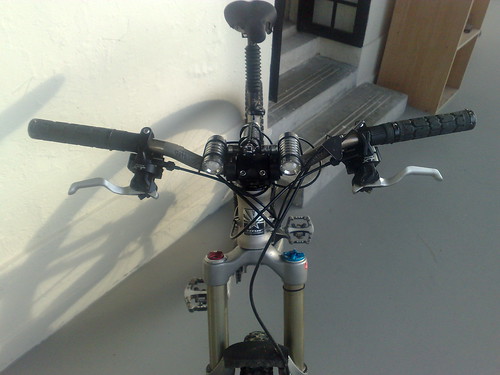
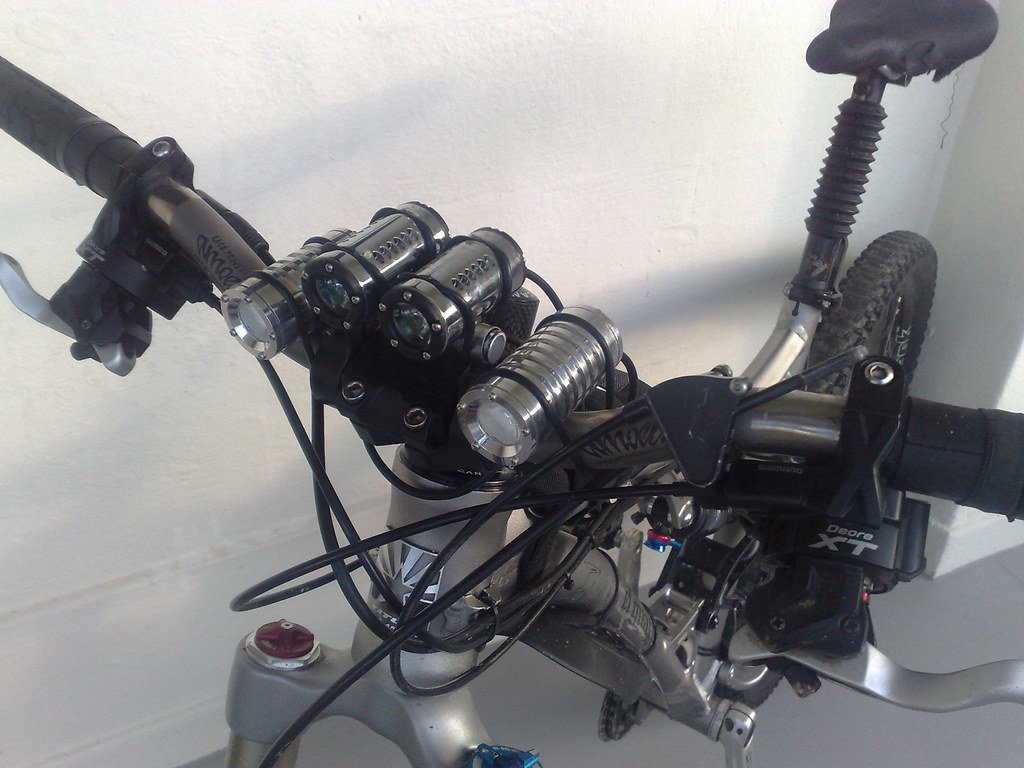
It was a world of a difference compared to just using my 2 Dinotte 200L previously.
Everything brightens up with the +500L output from the "Two"-matoes with med flood lens. With a single spot 200L mounted atop in the centre, it hardly made a difference. Guess for the center throw, will have to go with the full arsenal and twin up the Dinos. Battery pack is now a concern. Better start looking at Li paks....


Overkill?

Sunday, April 26, 2009

El Guapo ---- First Ride Report


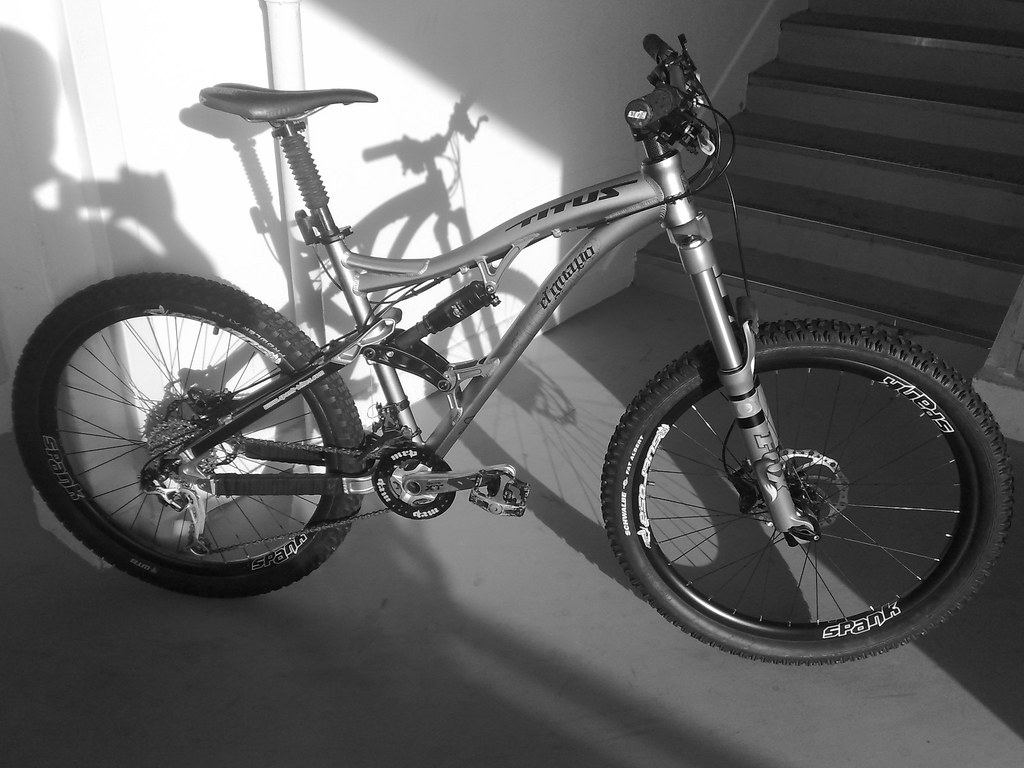
It doesn't help, recession or not, when what started out as a search in 07' for a practical do-it-all frame culminating into today's irresistable EG. While retaining the characteristics I've been looking for, a 6" bike that climbs as well as it would descend. Would have probably traded off the roadie and maybe even the SS just to get the EG. Thankfully none of that is necessary.

So a year and a half later... finally it's all setup staring back at me for the last 4 days before a chance to hit the trails this morning. Decided to do Ketam Trail with its series of rollers and rock gardens over good ol' speedy BT trail. After all the objective was to test the capability and see if it lives up to all that has been said. Guess more importantly, whether my search in the last 2 years on AM bikes has been on the mark. Really, I just needed to know that this is "The One" as I'm not one that enjoys changing bikes every 6 months.


A shot of the ending rocky section from a previous ride by Pris.


With the exception of the fork, now an 09' 36TALAS, a front TA Hope II hub, a 50mm stem and a CC Double XC Flush headset, everything was simply transferred over from the ML II, including tires. My rant with the ML was that it just wasn't enough bike to be called a Do-It-All rig. Every part that can be strengthened and beefed up had been done in the last year. It only meant 2 things, frame and fork....and thus the EG.

What a day to pick! Sweltering 34 degrees Celcius (or 93 degrees F) halfway into the ride with the usual 100% humidity under the jungle canopy. Totally dry throughout even though I'm writing now with a thunderstorm just brewing outside. Luckily we came back quickly enough. Weird weather these days!

Ok, ride report proper, first off, after adjusting the bar height down by 2 spacers, hitting the gravel straights did not feel much different in terms of body positioning despite the travel now at 160mm up front (vs my usual 120mm on the ML).

In fact it felt faster as the pedaling tempo picks up. To be fair, tire pressure is slightly higher than my norm and the dryness probably help with the increased speed. At this stage, dwelling on the suspensions is probably moot as they are being run in and the stiction on both front and rear is pretty apparent. Getting the front to sag 27-30% without wallowing and fork dive proves to be elusive for now. Hence things are a little stiffer than what they should be.

Next came the climbing test, but first, entry into the trail head was via the double black diamond rocky crop. Previously on the Motolite it was always a gingerly affair, more of the slow, steady xc-ish approach. The EG simply bomb down and ate it all up (after I checked and made sure the rebound on the fork was fast enough not to be packed down at the last drop off).

Lacking ride pics but with the burning heat and humidity, all we could do was focus on the riding.

Climbing
As usual, right after the rocks, straight from trail-head are the tight switch back climbs. At full travel, no problem whatsoever. The shorter 50mm stem now and better tracking from the stiff TA fork definitely helped. Even with a longer wheelbase than my ML, the EG turning is really responsive. And the most important thing that I've been looking for--- no lifting twitchy front. Ok. No. 1 point on my list, checked and crossed off.

With the encroaching heat making everyone heady after a few km, it became tempting to switch the travel down on the climb. But giving in to that came only much later. Was determined to test things out. Maybe I was too quick to comment elsewhere the adjustable travel is not needed. Then again maybe its just the weather. The only time the front starts to wander a bit is on steep eroded climbs with jutting square edges. On reflection, I guess it would happen to any bike.

BB height??
Ketam trail has not been known to be nice to bikes sporting low BB; with sections where one has to climb over foot high rocks right at the start. But with the familiarity on this trail and a bit of quarter cranking aided by the King's high engagements, there weren't any significant pedal strikes over what's usually experienced. Overall for a 6 inch travel bike, the BB height on the EG is and "feels" low. However that adds to its stability on the down. It probably contributed to the "beefed-up-xc-on-steroid" feel when I eventually turn the travel down to 130mm.

What about 100mm? Oh that really wasn't necessary even with me brains cooking away and dripping buckets over the top tube on the climbs sucking in more moisture than oxygen beneath the trees.

Descends
The roll down on the Double Black at the trailhead was confidence inspiring enough that for the rest that follows there was hardly a flicker of doubt as to what the bike can do when pointed down. Only nagging thought was the fork not having broken in yet. Braking power on the new front 7" rotor was a boost to confidently hit the levers late at the end of descends or turns. Twice it hit a couple of jutting rocks harder than I would have liked and the bike lifted off a little (attributed to sus not properly dialled in) but no problem, wherever i pointed it to land, it was spot on and the pedaling starts all over again as my mind meanders towards the next mental waypoint.

Taking a closer look while resting, the pivot placement refinement on a 4-Bar Horst-link seems to have paid off. I'm not terribly good at describing such things in technical terms but as one looks at the way the links move, the movements are not not excessive and I am throwing a lot of comparison with various designs I have seen. Not too sure of the plushness with a seasoned rear shock at this point. It's firm but on descends with a bit of speed over 1-2ft bumps, it hasn't thrown me off the saddle either. Seems like Titus sticking to a true and tried design is not a bad thing after all. The only thing I found better on the new and much touted DW design was taking the abrupt jolt out of square bumps. But being more of a type that relies on momentum and consistently shifting the body weight around all these years, the 4 bar Horst design has never been a problem for me. Just have to remember how a bike was ridden in the old hard tail way as I still do on my SS. 100% reliance on suspension to keep butt glued to the seat is simply a lazy way to ride imo.


The firm feel of the overall design with the rear RP23 is still my preferred choice on local trails. A DHX might be in store if I do decide to change the feel of things a bit or head north to our neighbour's for the bigger stuffs in Penang and KL.

Rant?

If there is anything, I would say the need to use a down-swing front dee. Never liked it as the shifting needs to be done under load for it to be precise.

Estimated weight puts the current EG built at 15.8kg today, that's ~35lb for the "metric"-challenged. This, compared to the small ML that weighed in at a hefty 14.68kg (32.2 lb).

Few other points to note. The cable stops and routings are really a nice touch on the EG. On a bare frame the stops on the headtube look a little out of place. But once everything is on, one starts to appreciate the fact that the cables aren't going to be flopping around the sides of the headtube. (I ran things slightly different with full cable housing though out, so the portion that goes through the shock is a little different than recommended)

Oh..just have to say this, the top tube is just uber sexy


One and only action shot as we finished off and headed for lunch.
Crappy bunny, not enuf tuck on equally crappy flats. Those pedals done their time, definitely needs to be changed. Anyway it seems now that clipless will be history for me.


Some Other Pics from today.
Pre-Ride: Pressure check, Equipment check


Group pic on the way back... as usual at the insistence of Orange Cam Whore :)


Bikes taking a well deserved break after being ridden hard.....


Let's Rock Da Boat........Owner of proud EG still too hyper to call it a day